



I took this picture in 2023 as one of the vestments on my birthday, after I was installed as Yèyé-Ọba. Anyone who has followed me closely know I am deeply invested in Yorùbá language, traditions, and culture. I started writing in Yorùbá language on Facebook when it was not fashionable to do so. Long before reels became a thing and Yoruba speakers could create content in Yoruba. One bigot came on my wall yesterday to ridicule me based on a version of this picture. In the process, he exposed his ignorance. This update is to cure him and his likes.
The conflation of indigenous regalia with “idolatry” is the unfortunate consequence of historical amnesia and religious bigotry. A failure to distinguish between sacred constitutional statecraft and liturgical worship. In Yorùbá civilization, garments like Sàkì and Ìtàgbè are not idols; they are the high vestments of judicial integrity, ancestral memory, and institutional authority.
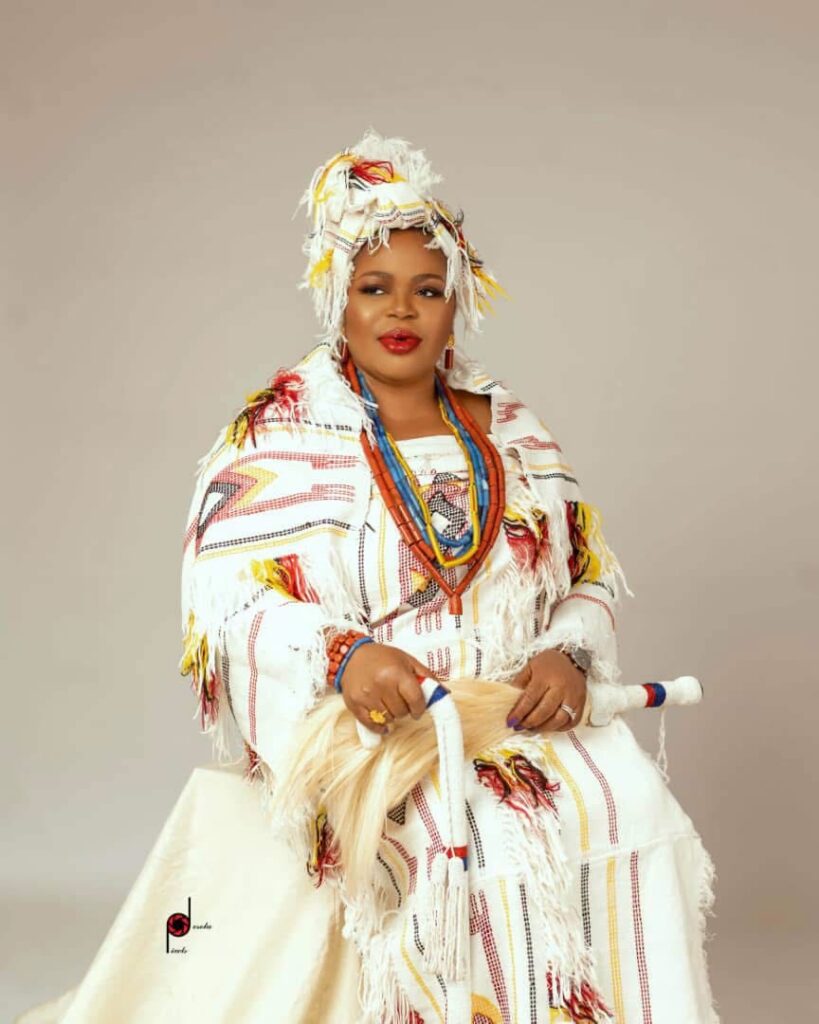
The Sacred Loom of Ṣàkì and Ìtàgbè
In traditional Yorùbá ontology, handwoven textiles are philosophical texts.
Ṣàkì: Woven with looped, tufted cotton pile to create a plush, textured surface, Ṣàkì is the zenith of traditional handloom artistry. Its dense, heavy weave symbolizes weightiness of character, maturity, and moral gravity (àgbàlagbà). It wraps the wearer in the enduring protection of communal heritage.
Ìtàgbè (The Mantle of Truth): Historically associated with the Òṣùgbó and Ògbóni institutions, the supreme arbiters of constitutional order, justice, and environmental custody in pre-colonial Yorùbáland, the Ìtàgbè is a ceremonial stole worn across the shoulder or chest. It signifies that the wearer is an instrument of truth (olóòótọ́) and a mediator between the community, the ancestors, and the living Earth (Ilẹ̀). The intricate woven motifs and tassels are mnemonic scripts of lineage, balance, and civic duty, not objects of prayer.
Constitutional Regalia, Not Deities
An English judge wearing a scarlet robe and wig, or an academic in velvet doctoral hoods, is not worshipping the cloth; they are embodying the dignity of their office.
The Vestment as Charter: Draping the Ìtàgbè and Ṣàkì is an assertion of civic legitimacy and chieftaincy. It is an emblem of moral restraint and institutional reverence.
The Regalia of Sovereignty: Accompanied by the Ìrùkẹ̀rẹ̀ (the beaded horsetail whisk symbolizing peace, imperial grace, and the authority to banish discord) and consecrated neck beads (Ìlẹ̀kẹ̀ Ìyùn and Sẹgi), the ensemble projects Àṣẹ, the sovereign power to speak life and order into society.
To reduce the ceremonial mantle of Yorùbá jurisprudence and regal heritage to the worship of a “false god” reveals a profound ignorance of African institutional history. Honoring Ìṣẹ̀ṣe through traditional attire is not theological competition; it is an act of cultural sovereignty, rootedness, and profound ancestral dignity. As the elders say: “A kì í fi orúkọ ọmọ ẹni fún ẹlòmíràn jẹ”, one does not surrender one’s heritage to the narrow lenses of others.
Written By By Bamidele Ademola-Olateju