
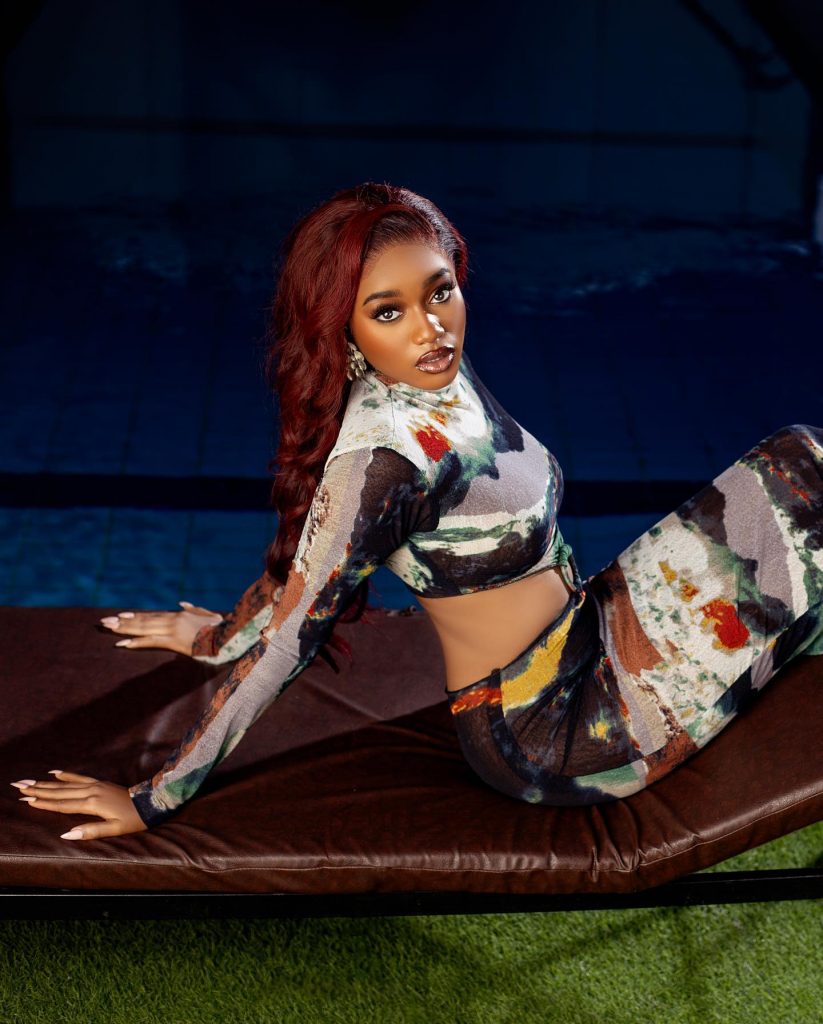
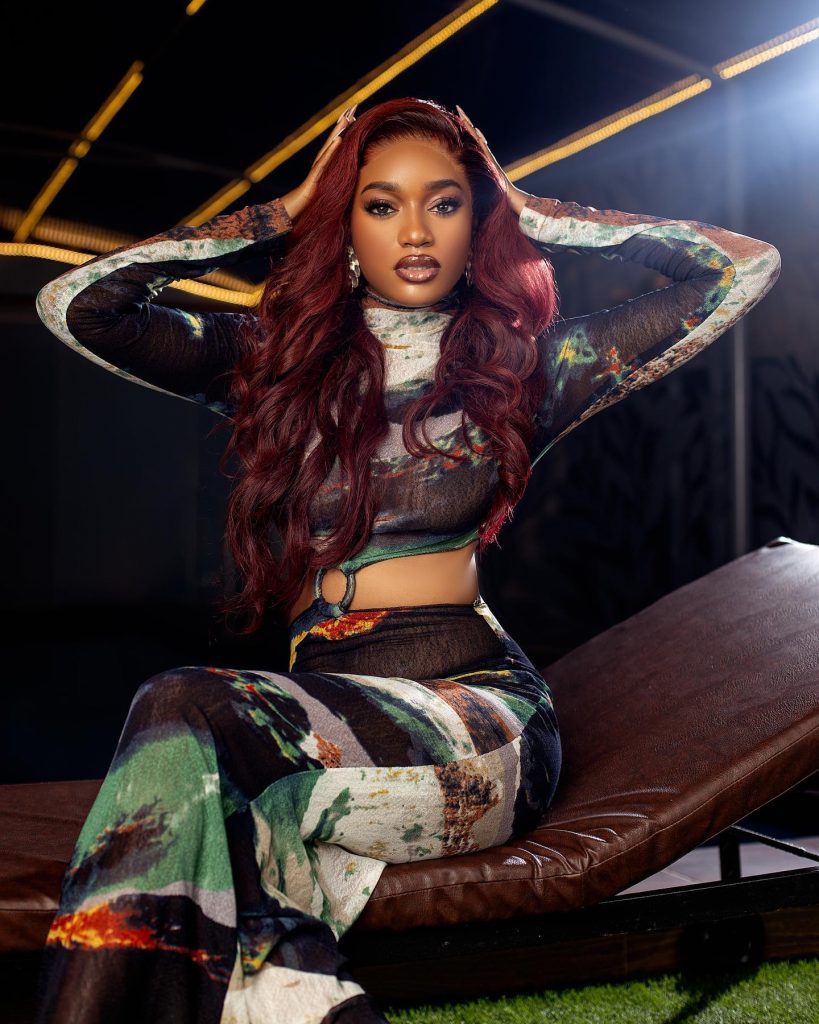
There are figures who enter an industry and adapt to fit its existing shape. Then there are those who arrive and quietly rearrange the furniture. Yaya Mavundla belongs firmly to the second group. The South African activist, artist, television personality, and style icon has spent the better part of a decade refusing the narrow corridors that the entertainment world tends to offer people like her, and in doing so, she has built something far more durable than fame. She has built a record.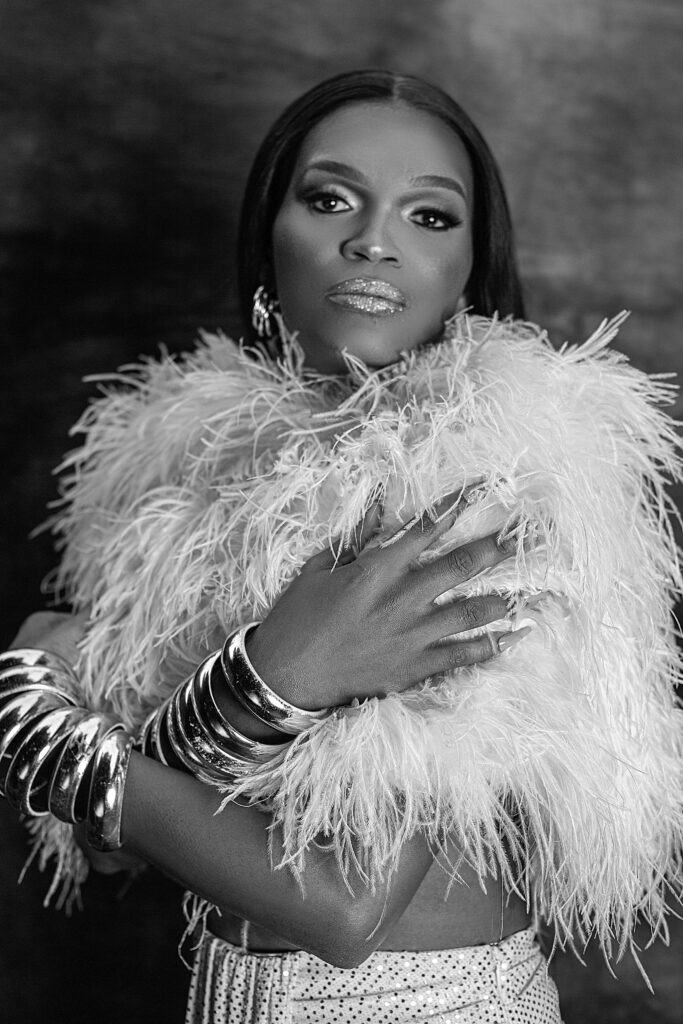
From the rural landscapes of Kranskop in KwaZulu-Natal to billboard placements in Luzerne, Switzerland, from the Constitutional Court of South Africa to the TEDx stage in Johannesburg, Mavundla’s career reads less like a climb and more like a series of doors opened from the inside. In 2024, Glamour South Africa named her its Most Glamourous Readers Choice Award winner. Forbes Africa nominated her for its Over 30 Under 50 list in 2025. She has graced the covers of Glamour, UniQ, Front Page News, Exit, Out Africa, Previdar, and Top Charts South Africa, among others. The Feather Awards have recognised her three times across different categories over seven years.
And yet, sitting with her story, one quickly understands that accolades are the residue of something deeper, not the point of it.
THE MAKING OF AN ACTIVIST
Mavundla is candid about the fact that her activism was not a deliberate strategy. It grew out of survival and self-respect.
“I became an activist without even realising it at first,” she has said. “Simply living my truth as a transgender woman became a form of visibility, and that visibility naturally turned into activism.”
When she began working in the South African entertainment industry, the landscape for openly transgender people was sparse. Transgender individuals existed, of course, but few were stepping forward in the media to speak about their experiences with any consistency or candour. Mavundla recognised the weight of that silence and chose, deliberately, to fill it.
Her introduction to mainstream audiences came through Becoming, the reality television series broadcast on Mzansi Magic and Showmax that followed the lives of transgender people across South Africa. The programme gave her a platform, but it was how she used that platform in the years that followed which defined her standing. She did not simply become a television personality. She became a reference point.
“I’ve always wanted my brand to be known first as that of a transgender activist. It’s important for people to understand why individuals like myself belong in the entertainment industry and in society at large.”
In 2018, she became the first person in Africa to wear the Amsterdam Rainbow Dress, photographed at the Constitutional Court. In July 2024, on Mandela Day, she delivered a TEDx talk at the TEDxJohannesburgSalon, becoming the first transgender woman in Africa to do so at that forum. These were not simply firsts for their own sake. Each moment was deliberate, chosen for its symbolic weight and its capacity to shift the terms of a conversation that needed shifting.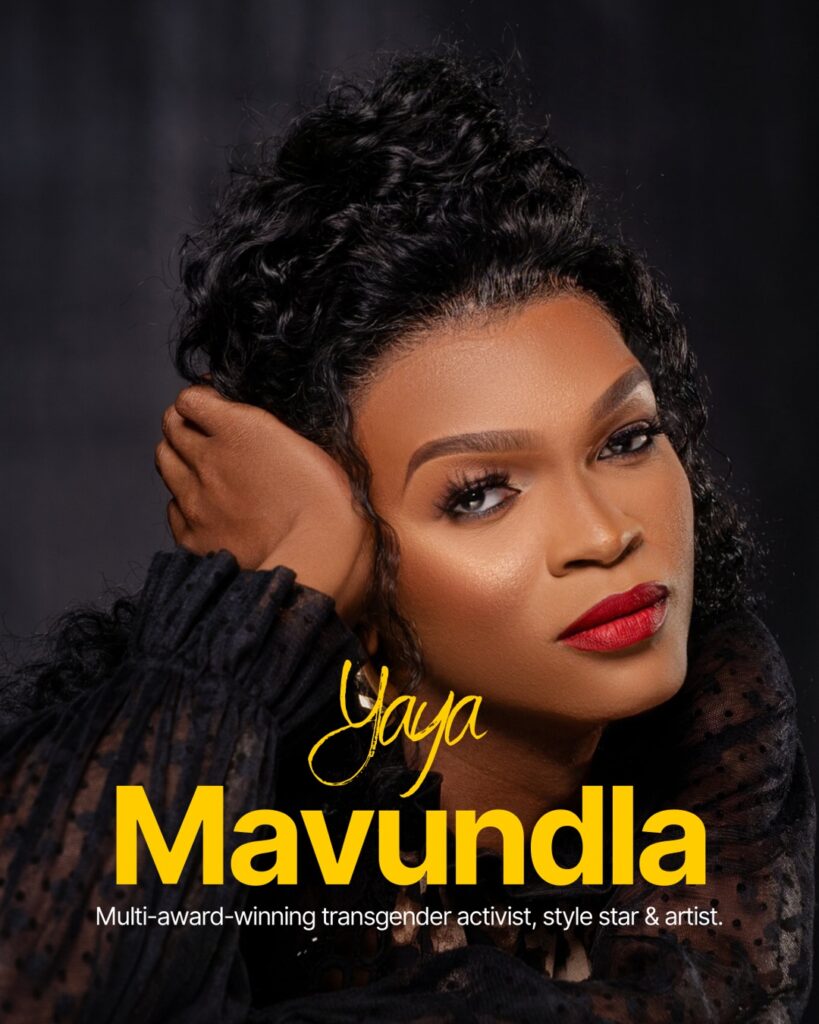
WHAT THE AWARDS ACTUALLY MEAN
To understand Mavundla’s body of recognition, it helps to read it chronologically. In 2018, the Feather Awards named her Socialite of the Year. By 2021, the same awards honoured the production Becoming with the Media of the Year designation, while the Sowetan Women’s Club named her Trendsetter of the Year. The Fashion Industry Awards SA gave her Fashion Muse of the Year in 2022. Then came the Feather Awards again in 2023, this time for Best Style Personality. Glamour’s Readers Choice Award followed in 2024.
What this arc shows is not a person who arrived fully formed and was immediately celebrated. It shows a career built with method, one that accumulated credibility across fashion, media, and advocacy simultaneously, until the recognition had little choice but to follow.
She is measured about what these milestones represent. “Every magazine cover, nomination, and award I have received is the result of hard work and a deep commitment to my story,” she has noted. But she is also clear that her personal satisfaction is secondary to the message these achievements send outward.
“I wanted to set an example that transgender women can also reach incredible milestones, even when many doors are closed to us. More than anything, I wanted to send a message to those who are often told they are not worthy that it is absolutely possible.”
For a Black transgender woman from Kranskop, to be celebrated in spaces that have historically not been designed with people like her in mind carries a significance that no award citation fully captures.
THE CONVERSATION AFRICA STILL NEEDS TO HAVE
When the subject turns to the broader state of transgender life across the continent, Mavundla is neither dismissive nor despairing. She is precise.
In many African countries, transgender people remain unable to live openly without facing violence, legal obstruction, or systematic exclusion from employment and public life. The world has moved, in parts, toward greater inclusion. But that movement has been uneven, and much of the continent has not moved with it.
“The portrayal of LGBTIQ+ people in the media has not always been positive,” she observes, “and that has shaped how many people perceive our community.”
“When someone meets me for the first time, I want them to see a respectable woman and judge me based on my character rather than assumptions about my identity.”
Her approach to this has been consistent. She has worked to ensure that the first impression she makes is one of competence, composure, and credibility, partly to represent herself well, and partly because she understands that every interaction carries the weight of representation.
“I wanted decision-makers to understand that our lives and stories matter just as much as anyone else’s,” she says. The difference is that transgender stories are so often framed around suffering and exclusion that the full picture, the resilience, the creativity, the success, rarely gets the same air.
Her 2022 clothing line, Queer Comfort, and her art exhibition Black, Trans and Bold, which was shown solo at the historic Women’s Jail at Constitution Hill, are both deliberate contributions to that fuller picture. They say, with some force, that transgender people are not only subjects of advocacy. They are also makers and creators.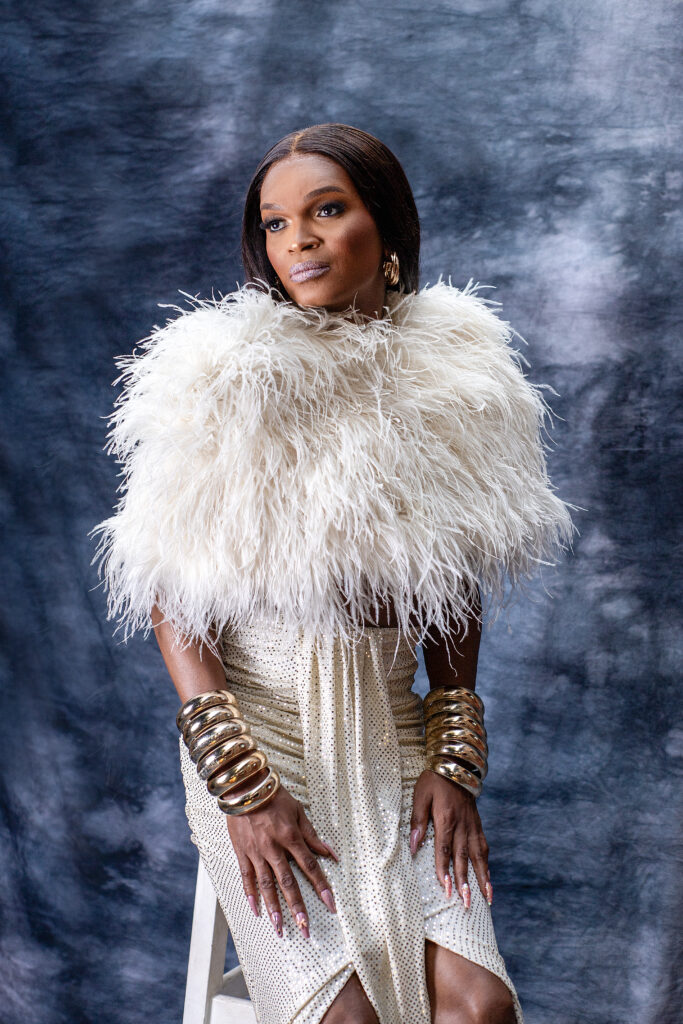
THE STAGE SHE HOLDS
Beyond her own work as an artist and public figure, Mavundla has become one of South Africa’s most sought-after hosts for high-profile occasions. The list covers considerable ground: the Miss World South Africa Red Carpet broadcast live on SABC3, the South African Music Awards Red Carpet for Proudly SA, the 5th JoBurg Film Festival, the International Pride Awards live show, the Glamour Beauty Awards, and the Queer Met in partnership with Jean Paul Gaultier, among others.
In 2025, her hosting calendar continued to expand, taking in the Fashion Industry Awards SA Red Carpet on SABC3, the Johannesburg Pride Main Stage, a Women’s Month Trans Summit, and Klein Constantia’s 340 Years Celebration.
This range is not incidental. A host who can move between a major commercial broadcaster, a heritage wine estate, and a pride main stage is someone whose appeal crosses the usual category lines. Mavundla is not a niche figure operating within a clearly defined lane. She is a public communicator whose reach has been built through consistency of character rather than the careful management of a single image.
WHAT IS COMING
The question of what comes next is one Mavundla approaches with her characteristic combination of purpose and patience. Her upcoming projects return to the documentary and narrative television space, this time with a sharper focus on celebrating the lives of transgender individuals who have chosen to live as their true selves.
The project is, in her own framing, a continuation of the work that Becoming started. It seeks to document not merely individual transitions but the collective history of trans life in Africa, placing personal stories within a wider social and cultural context. The aim is both educational and affirmative: to challenge the stereotypes that persist and to confirm, through lived example, that every story within this community has value and deserves to be heard.
For audiences, the series promises a depth that goes well beyond the surface. For Mavundla personally, it represents another stage in a career that has always been driven less by opportunity and more by obligation, the sense that if these stories are not told, they may not be told at all.
“This is the journey of becoming. Not just individual transitions, but the collective narrative of trans history in Africa.”
THE LEGACY SHE IS BUILDING
Ask Mavundla what she wants to be remembered for, and the answer is neither complicated nor adorned.
“The legacy I hope to leave behind is the story of a Black transgender woman in Africa who had the courage to speak and live her truth.”
There is something quietly radical about that aspiration, not in the sense of spectacle, but in its refusal of concealment. She has been offered, implicitly and explicitly, the possibility of softening her identity for the sake of acceptance. She has declined, repeatedly and without apparent regret.
“Even when the world suggested that I should hide who I am for opportunity, I chose to be myself, especially in a world where everyone else is freely afforded the chance to live as their authentic selves.”
For the generation of African creatives and activists who are watching her career, that choice has a practical as well as a moral dimension. It demonstrates that a public figure can build lasting credibility without compromising the core of who they are. It demonstrates that markets, audiences, and institutions can be moved by honesty as much as by strategy.
“My hope is that the path will be a little easier for those who come after me, because someone before them chose to stand in their truth.”
That is, in the end, the most honest statement of what Yaya Mavundla’s career has been about. Not the awards, formidable as they are. Not the magazine covers, numerous as they have become. Not the firsts, which are genuinely remarkable. But the ongoing act of showing up, fully and without apology, and in doing so, making it marginally less difficult for the next person to do the same.
In a continent still working through the meaning of inclusion, that is not a small thing. It is, in fact, the work.