


I have lived long enough to understand that Nigeria cannot be explained by statistics alone.
Nigeria is better understood through memory.
It is in the stories our parents told us about independence. It is in the black-and-white photographs of our first leaders. It is in the old radio sets through which Nigerians listened to political speeches. It is in the excitement surrounding the lowering of the Union Jack and the raising of the Nigerian flag on October 1, 1960.
It is also in the stories of disappointment that followed.
There were coups, counter-coups, a civil war, military dictatorships, disputed elections, economic crises, corruption scandals, religious and ethnic tensions, unemployment, insecurity and years when democracy itself appeared to be a distant dream.
Yet here we are.
Sixty-six years after independence, Nigeria remains standing.
That fact deserves reflection.
Not because everything has gone well. It has not. Not because the Nigerian project has been completed. It has not. Rather, because the history of Nigeria is the story of a people who have repeatedly encountered moments that could have broken the country, yet somehow found ways to continue.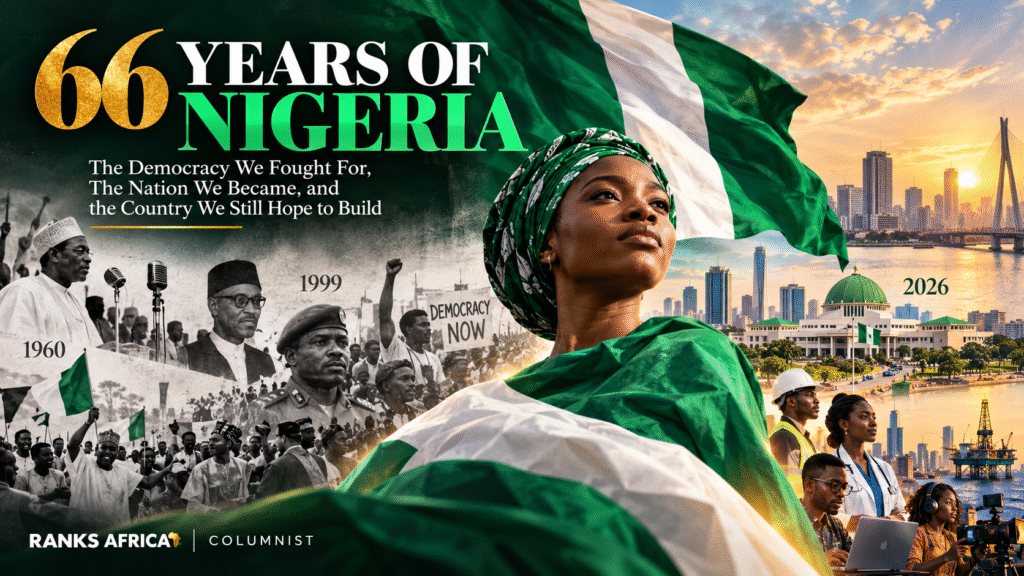
Nigeria’s 66th Independence Anniversary is therefore more than a celebration of a date. It is an opportunity to examine the long journey from colonial rule to self-government, from parliamentary democracy to military intervention, from civil war to political reconstruction, from the Second Republic to another period of military rule, and finally to the Fourth Republic, which has now provided the country’s longest uninterrupted period of civilian government.
The official history of Nigeria’s electoral institutions tells us that the Electoral Commission of Nigeria conducted the 1959 elections that preceded independence. The Federal Electoral Commission subsequently conducted the 1964 federal and 1965 regional elections before the military intervention of January 1966. Nigeria’s democratic journey has therefore never been a straight line.
But history is rarely a straight line.
The Nigeria We Inherited
When Nigeria became independent on October 1, 1960, the country inherited a constitutional system that had been negotiated during the final years of British colonial rule.
It was a moment of enormous expectation.
Nigeria had achieved independence without the kind of prolonged armed liberation struggle experienced by some other African countries. Political leaders had negotiated constitutional reforms, contested elections and gradually assumed greater responsibility for governing the emerging nation.
Sir Abubakar Tafawa Balewa became Prime Minister. Dr Nnamdi Azikiwe became Governor-General.
But independence in 1960 was not yet the complete constitutional break many Nigerians imagined.
The British monarch remained the formal head of state, represented in Nigeria by the Governor-General. Nigeria’s highest court of appeal was also still the Judicial Committee of the Privy Council in London. In 1963, Nigeria became a republic, replacing that arrangement with a Nigerian head of state and establishing the Supreme Court as the country’s highest court.
Those constitutional changes mattered.
They represented another step in the process of turning political independence into institutional sovereignty.
The first generation of Nigerian politicians had inherited a complicated country.
There were three major regions. There were numerous ethnic groups. There were different religious traditions, languages and political interests. There were also considerable economic differences between regions.
The challenge was never simply to remove British authority.
The challenge was to build a country from the pieces left behind by colonial administration.
That challenge remains with us.
The First Great Democratic Test
The early years of independence were politically turbulent.
Nigeria’s first democratic experiment was subjected to pressures that would eventually overwhelm it.
The 1964 federal elections and the 1965 regional elections became deeply contentious. Political competition became increasingly fierce, and disputes over electoral processes contributed to an atmosphere of crisis.
Then came January 15, 1966.
The military intervened.
That moment changed Nigeria permanently.
The young republic entered an era in which soldiers, rather than elected politicians, would repeatedly determine who governed the country.
For many Nigerians born after 1999, military rule is history.
For those of us who remember its consequences, it is something else.
It is memory.
Military governments came with promises.
They promised discipline.
They promised to fight corruption.
They promised to restore order.
They promised to correct the failures of politicians.
But military intervention created its own political and institutional consequences.
The suspension of democratic institutions became normalised. Political parties disappeared. Constitutions were suspended or altered. Citizens became subjects of decrees rather than participants in a functioning democratic process.
And then Nigeria entered its darkest national chapter.
The War That Tested the Idea of Nigeria
The Nigerian Civil War, fought between 1967 and 1970, remains one of the most painful episodes in our national history.
The conflict followed political instability, violence, competing claims over national power and the declaration of the independent Republic of Biafra.
Millions of Nigerians suffered.
Families were separated.
Children became refugees.
Entire communities were destroyed.
Food became a weapon of war.
The human cost was immense.
Yet the end of the war also produced one of the most important political declarations in Nigerian history: the idea of reconstruction and reconciliation.
Nigeria had survived a conflict that could have permanently destroyed the federation.
The country did not emerge untouched.
But it emerged as one country.
That history should be remembered carefully, because the preservation of Nigeria has never been guaranteed simply because Nigeria exists on a map.
Every generation has had to make its own contribution to keeping the country together.
The Second Republic and Another Democratic Opening
The return to civilian government in 1979 created another moment of hope.
The Second Republic introduced a presidential system and brought elected politicians back into national government.
Alhaji Shehu Shagari became president.
Once again, Nigerians were voting, political parties were competing, and elected institutions were functioning.
But the experiment lasted only four years.
In December 1983, the military returned.
Once again, democracy was suspended.
The lesson became painfully familiar.
Nigeria could establish democratic institutions, but sustaining them was another matter.
This distinction is crucial.
Democracy is not simply an election.
An election can produce a government.
Democracy requires something much larger.
It requires institutions capable of surviving political disagreements. It requires citizens who can criticise government without fearing the state. It requires courts that can adjudicate disputes. It requires a legislature capable of exercising oversight. It requires a press that can investigate power. It requires political parties that understand that losing an election is not the same thing as losing one’s country.
Nigeria spent decades learning these lessons, often painfully.
June 12 and the Price of Political Freedom
Then came June 12, 1993.
That election remains one of the defining moments in Nigeria’s democratic history.
The election was annulled, plunging the country into another political crisis.
The years that followed were difficult.
Activists were imprisoned.
Journalists were harassed.
Political opponents were persecuted.
Many Nigerians went into exile.
Civil society organisations intensified their resistance.
The struggle for democracy became more than a contest among politicians. It became a broader demand for political freedom.
The names associated with that period are now part of Nigeria’s democratic memory.
M.K.O. Abiola.
Kudirat Abiola.
Gani Fawehinmi.
Beko Ransome-Kuti.
Alfred Rewane.
Bola Ige.
Anthony Enahoro.
Shehu Musa Yar’Adua.
And many others whose contributions did not always receive the attention they deserved.
In its 2026 Democracy Day address, the Presidency also recognised a long list of activists, journalists, labour leaders and political figures whose resistance helped sustain the struggle for democratic government. (State House)
Their stories remind us that democracy was not handed to Nigerians as a gift.
People fought for it.
Some lost their freedom.
Some lost their livelihoods.
Some lost their lives.
1999: The Door Finally Opened
The death of General Sani Abacha in 1998 changed the political atmosphere.
General Abdulsalami Abubakar subsequently led the transition that culminated in the return to civilian rule in 1999.
On May 29, 1999, Nigeria entered the Fourth Republic.
Olusegun Obasanjo became president.
For many Nigerians, there was a feeling that something historic had happened.
The soldiers had finally returned to the barracks.
The ballot box had returned to the centre of political life.
The country had another opportunity.
And this time, something different happened.
The experiment lasted.
Four years became eight.
Eight became sixteen.
Sixteen became twenty-four.
Today, Nigeria has experienced 27 uninterrupted years of civilian government since 1999.
The country’s electoral management body, INEC, records that it has conducted federal elections in the Fourth Republic in 1999, 2003, 2007, 2011, 2015, 2019 and 2023.
That continuity is significant.
Nigeria has experienced transfers of political power through elections.
Presidents have left office.
Opposition parties have won elections.
Incumbents have been defeated.
Courts have heard electoral disputes.
Parliaments have changed.
Political alliances have shifted.
The country has continued.
That is one of the major democratic achievements of the post-1999 era.
Democracy Is More Than A Presidential Election
There is a tendency in Nigeria to measure democracy by the person occupying Aso Rock.
That is too narrow.
Democracy is also the local councillor.
It is the state legislator.
It is the governor.
It is the judge.
It is the journalist who asks an uncomfortable question.
It is the civil society organisation that demands accountability.
It is the citizen who challenges a government decision in court.
It is the opposition politician who is allowed to organise.
It is the voter who can change his or her mind.
It is the young Nigerian who can openly criticise government policy on a phone without needing permission from a military administrator.
The institutions may be imperfect.
They may be contested.
They may require reform.
But their existence matters.
Nigeria’s electoral institutions have also evolved technologically. INEC’s current framework includes tools such as the Bimodal Voter Accreditation System and the INEC Result Viewing portal as part of efforts to modernise electoral administration.
These developments do not eliminate electoral disputes.
They do, however, demonstrate that democratic institutions can change with society.
The Nigeria That Surprised the World
If we look beyond politics, the Nigerian story becomes even more complicated.
There is another Nigeria.
It is the Nigeria of entrepreneurs.
The Nigeria of filmmakers.
The Nigeria of musicians.
The Nigeria of technology developers.
The Nigeria of fashion designers.
The Nigeria of farmers.
The Nigeria of engineers.
The Nigeria of doctors and nurses.
The Nigeria of academics.
The Nigeria of writers.
The Nigeria of comedians.
The Nigeria of young people creating businesses from bedrooms and university hostels.
The Nigeria of Nollywood, Afrobeats and Nigerian literature.
These industries have carried Nigerian culture far beyond our borders.
Nigerian musicians now perform on some of the world’s largest stages.
Nigerian films travel internationally.
Nigerian authors continue to shape global conversations about Africa.
Nigerian entrepreneurs build companies serving customers across continents.
Our diaspora has become an enormous extension of the Nigerian story.
This is one of the country’s greatest success stories.
Nigeria has never lacked talent.
Our recurring problem has been creating systems capable of converting that talent into broad prosperity.
The Contradiction Called Nigeria
This is where the Nigerian story becomes difficult.
We are a country of enormous resources and widespread poverty.
We produce some of the world’s most talented young people while struggling to create enough quality jobs for them.
We have enormous agricultural potential while importing significant quantities of food.
We have produced world-class creative industries while many practitioners struggle with infrastructure, financing and intellectual property protection.
We have universities producing brilliant graduates while employers frequently complain about skills gaps.
We have oil and gas resources, yet energy supply remains one of the country’s most persistent economic problems.
We have some of Africa’s wealthiest individuals and millions of people struggling with the cost of everyday necessities.
These contradictions should not be hidden on Independence Day.
They should be discussed.
Patriotism without honesty becomes ceremony.
And Nigeria needs more than ceremony.
The Democracy We Have Today
The Nigeria of 2026 is not the Nigeria of 1960.
It is not even the Nigeria of 1999.
Our society has changed dramatically.
Technology has changed political communication.
Social media has changed journalism.
Young Nigerians have become more politically vocal.
Women occupy positions of influence across business, government, entertainment and civil society.
The Nigerian diaspora is more connected to the country.
The private sector has become more sophisticated.
The creative economy has expanded.
Our cities have transformed.
The expectations of citizens have changed.
Yet our institutions have not always moved at the same speed.
This creates tension.
Young Nigerians do not want to inherit the political culture of their grandparents.
They want accountability.
They want opportunity.
They want security.
They want functioning public services.
They want to be able to build careers without having to leave the country.
They want government to explain itself.
And they increasingly have the technological tools to make their voices heard.
That is democracy developing in real time.
But We Must Also Tell the Hard Truth
Nigeria’s democracy remains unfinished.
There are still concerns about electoral integrity, political violence, accountability, institutional independence, corruption, insecurity, poverty and economic opportunity.
There are still citizens who feel disconnected from government.
There are still communities where the presence of the Nigerian state is weak.
There are still elections where allegations and disputes dominate public confidence.
There are still politicians who treat political office as personal property.
There are still citizens who sell their votes because immediate survival sometimes appears more important than distant political promises.
There are still young Nigerians who believe their future lies elsewhere.
These are not reasons to abandon democracy.
They are reasons to take democracy seriously.
The Presidency itself acknowledged in June 2026 that Nigeria’s democratic system is imperfect and argued that its institutions must continue to be strengthened.
That admission matters because mature democracies are not built by pretending that everything is working.
They are built by identifying what is broken and repairing it.
Sixty-Six Years Later
Today, when the Nigerian flag rises, I think about the generations that came before us.
I think about those who celebrated independence in 1960 believing they were witnessing the beginning of something extraordinary.
Some lived to see their dreams challenged.
Some lived through war.
Some experienced military rule.
Some went into exile.
Some were imprisoned.
Some never returned home.
Others stayed and built.
They opened businesses.
They established schools.
They founded newspapers.
They created factories.
They wrote books.
They made films.
They composed music.
They built hospitals.
They raised children.
They contributed to communities.
They kept believing.
And that, perhaps, is the most Nigerian thing of all.
We complain about Nigeria constantly.
Sometimes rightly.
Sometimes excessively.
But Nigerians continue to build.
A trader opens a shop.
A farmer plants another crop.
A filmmaker starts another production.
A young programmer writes another line of code.
A teacher enters another classroom.
A doctor begins another shift.
A mother sends another child to school.
An entrepreneur takes another risk.
A citizen votes again.
The country moves.
The Meaning of Independence Today
Independence should not simply mean remembering when the British flag came down.
Political independence was the beginning.
The deeper question is what Nigerians have done with it.
Have we built institutions stronger than individuals?
Have we created opportunities broad enough for ordinary citizens?
Have we protected the rights of minorities?
Have we made justice accessible?
Have we treated public resources as a trust?
Have we built an economy capable of supporting the aspirations of our young population?
Have we created a country where a child born in a poor household can still dream realistically about becoming anything?
These are the questions that should define the next chapter.
Because the Nigeria of the future will not be built by government alone.
It will be built by citizens.
By entrepreneurs.
By teachers.
By artists.
By farmers.
By scientists.
By journalists.
By politicians.
By religious and traditional leaders.
By young people.
By Nigerians at home and abroad.
The Country We Must Hand Over
Sixty-six years is a long time in the life of a person.
It is still relatively young in the life of a nation.
Nigeria has made mistakes.
Nigeria has survived crises.
Nigeria has produced extraordinary people.
Nigeria has disappointed its citizens.
Nigeria has surprised the world.
Nigeria has fallen short of its possibilities.
Nigeria has also demonstrated, repeatedly, that its possibilities are enormous.
The task before the next generation is not to romanticise Nigeria.
It is not to condemn Nigeria either.
It is to build Nigeria.
Our founding generation fought for independence.
The generation that followed fought to preserve the federation.
The pro-democracy generation fought for political freedom.
The Fourth Republic generation has spent 27 years trying to make civilian rule durable.
The generation now coming of age must ask a different question:
What should Nigerian democracy actually deliver?
The answer cannot simply be elections.
It must be dignity.
It must be opportunity.
It must be justice.
It must be security.
It must be functioning institutions.
It must be a country where talent does not have to leave before it can flourish.
It must be a country where citizenship is not merely an identity on a passport but a relationship between the individual and the state.
That is the unfinished work.
Happy 66th, Nigeria
On this 66th Independence Anniversary, we should celebrate.
But we should celebrate with our eyes open.
Let us remember the joy of 1960.
Let us remember the turbulence of the First Republic.
Let us remember the pain of the Civil War.
Let us remember the years of military rule.
Let us remember June 12.
Let us remember the activists, journalists, workers, students, politicians and ordinary Nigerians who paid prices for political freedom.
Let us remember 1999.
And let us remember that democracy survived because Nigerians kept insisting that it should.
The Nigerian story is not finished.
Perhaps that is its greatest strength.
There are still chapters to write.
There are still institutions to build.
There are still wrongs to correct.
There are still young Nigerians whose talents are waiting for opportunity.
There are still communities waiting for development.
There are still dreams waiting for the Nigerian state to catch up with them.
Sixty-six years after independence, Nigeria is still becoming.
And after four decades of watching this country struggle, stumble, recover and rise again, I have come to one conclusion:
Nigeria’s greatest story is not that we have arrived. It is that, despite everything, we have refused to stop moving.
Happy 66th Independence Anniversary, Nigeria.
May the next chapter be written with greater wisdom, stronger institutions, wider opportunity and a deeper understanding of what it means to belong to this extraordinary country.
God bless Nigeria.
Adesina Kasali | Ranks Africa Columnist
October 1, 2026 | Independence Day Special