



ARUGBA: THE SACRED CARRIER OF YORUBA MEMORY
Inside the history, spirituality and cultural significance of the Arugba of Osun-Osogbo
Some histories survive in monuments, museums and written archives. Others survive because a people keep performing them, year after year, in ritual, in landscape, in language and in memory. The Osun-Osogbo Sacred Grove, on the banks of the Osun River in Osun State, belongs to the second kind of history. 
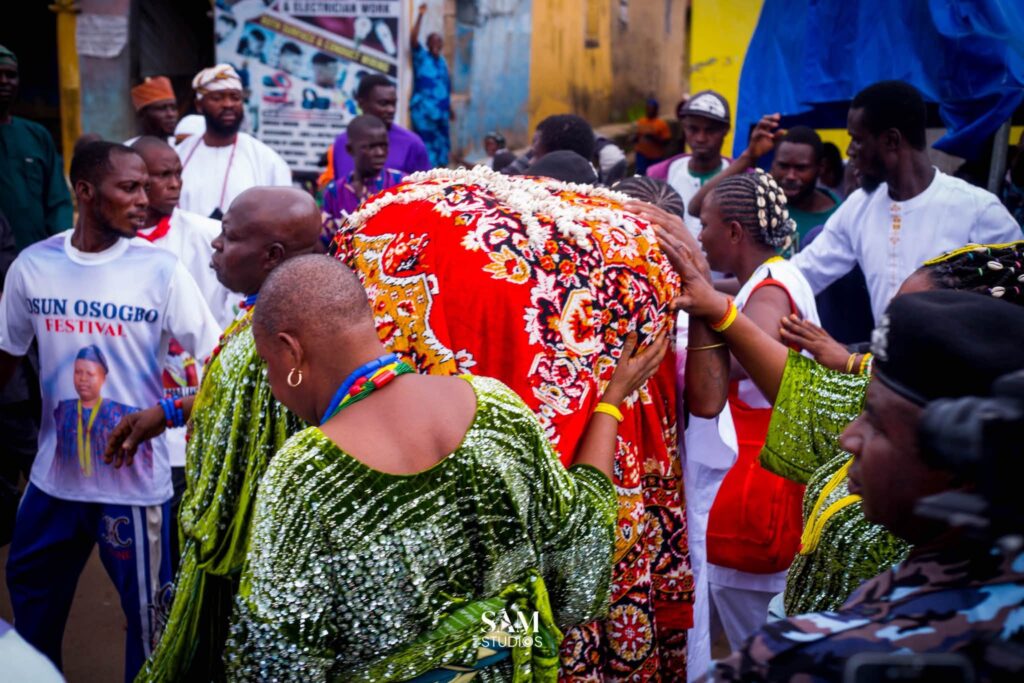
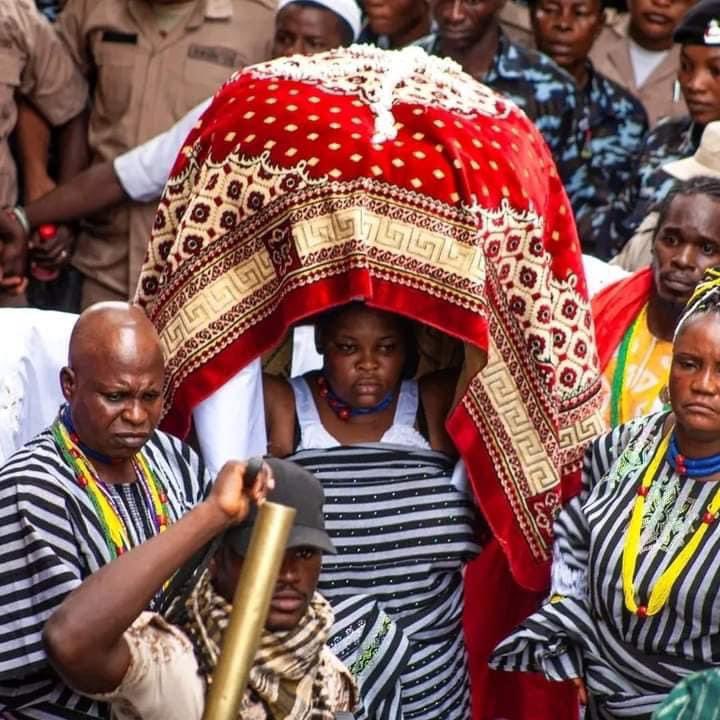
Every year, an ancient relationship between people, nature, kingship and the sacred is renewed there through the Osun-Osogbo Festival. At the center of the festival’s most important procession walks the Arugba, the young votary maid who carries the sacred calabash toward the shrine of Osun. To a visitor unfamiliar with the tradition, she may look like one figure among many in a striking cultural procession. To the people whose history she carries, she is something far more specific: a ritual institution, a bearer of communal prayer and a living link between generations, standing at the center of the continuing relationship between Osogbo and the river goddess who gave the town its name.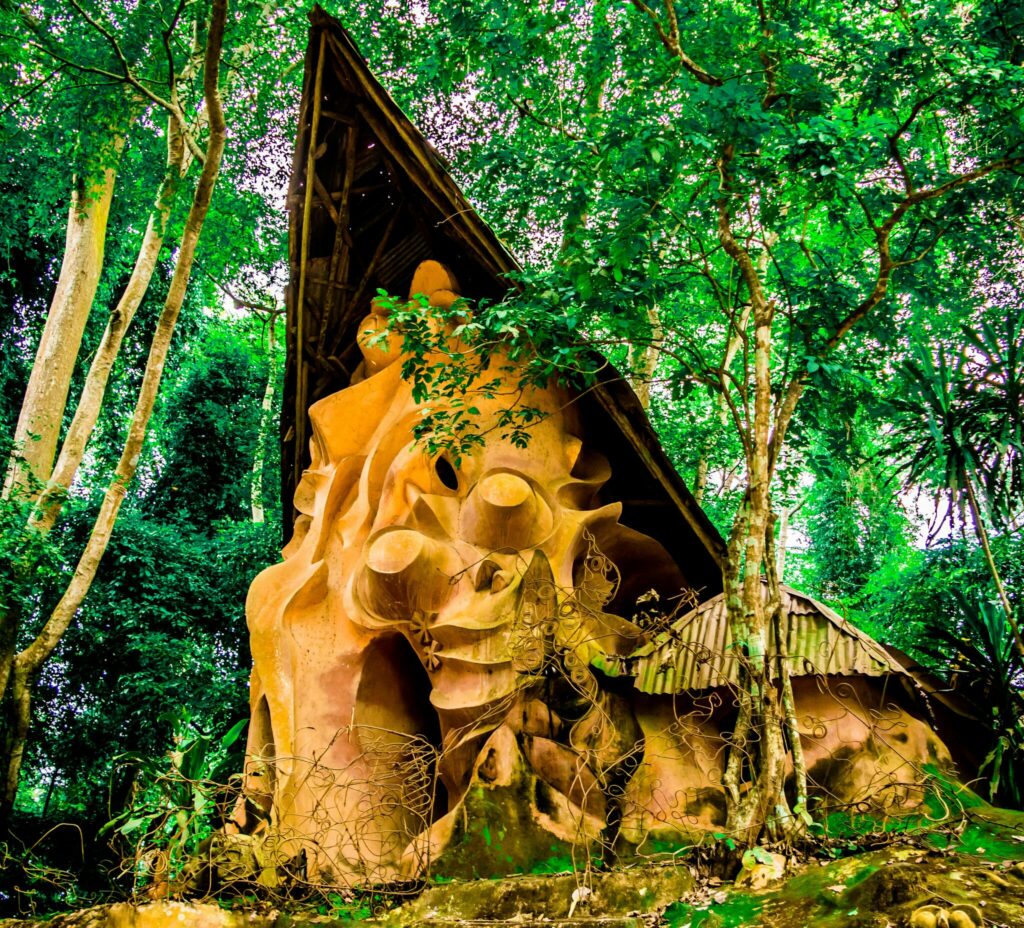
The National Commission for Museums and Monuments describes the Osun-Osogbo Sacred Grove as several centuries old, one of the last surviving sacred forests that once stood beside many Yoruba settlements. UNESCO inscribed the grove on its World Heritage List in 2005, citing its exceptional cultural significance and its continuing expression of Yoruba cosmology.
A tradition rooted in the founding memory of Osogbo
The history of the Arugba cannot be separated from the founding history of Osogbo itself. Oral tradition preserved by the people of Osogbo land ties the town’s early history to a relationship between its founding rulers and Osun, the river deity whose presence shapes the entire sacred landscape.
 National cultural documentation places this relationship between Osun and Osogbo’s early monarch at the centre of the festival, though the sources do not agree on every detail. The National Institute for Cultural Orientation associates the tradition with Oba Gbadewolu Laroye, while the National Commission for Museums and Monuments uses the name Oluwatimilehin to describe the founding encounter. Such variation is typical of oral historical traditions, which often preserve the same cultural memory through different names, genealogies and narrative forms. For that reason, it is more accurate to describe the Osun-Osogbo tradition as several centuries old rather than to anchor it to a single contested date.
What the different accounts agree on is the underlying idea. Osogbo’s survival became bound up with a sacred relationship involving Osun, the river and the town’s founding kingship, and that relationship is renewed each year through the festival.
Who is the Arugba?
The word Arugba is usually translated as “the carrier of the calabash,” though the title alone does not convey the weight of the office. The Arugba is a young woman selected for the role of votary maid. The National Commission for Museums and Monuments describes her as a young woman of kingly lineage who takes part in the central ritual and presents the sacrifice to the deity, while the National Institute for Cultural Orientation describes her as the bearer of the community’s age-old prayers, carried in a ritual calabash.

She is not a dancer, a parade performer or a festival hostess. She holds a sacred position within the ritual structure itself. During the procession, she carries the ritual calabash from the community toward the Osun shrine inside the sacred grove, and that walk carries meaning beyond its physical distance. The Arugba bears an offering, but she also bears the intentions of everyone who has entrusted a prayer to that journey.
The calabash and the language of prayer
The calabash is one of the most important objects associated with the Arugba, and in Yoruba traditional thought, ritual objects often draw their meaning from the relationship between the object itself, the ritual act, the sacred location and the spiritual reality being addressed. Within the festival, the calabash becomes far more than a container. It becomes a vessel through which the community’s petitions travel toward Osun.
 People arrive at the grove carrying different hopes. Some seek children. Some seek healing. Some seek prosperity or protection, or come to fulfil a vow made in an earlier year. Others come simply to honour the practice of their ancestors. The Arugba gathers these separate, private intentions into a single communal act and walks with them, so that the calabash becomes the physical form of that collective supplication. It is this weight of purpose, rather than the visual spectacle of the procession, that gives the Arugba her real significance.
The spiritual significance of Osun
Understanding the Arugba requires some understanding of Osun herself. Within Yoruba religious thought, Osun is an important òrìṣà associated with the river and with fertility, healing, motherhood, beauty, prosperity and generative power. Academic scholarship has examined her position within Yoruba cosmology and the ways her spiritual identity has come to be read in relation to fertility, healing and female power.
 The river sits at the centre of this understanding. Water sustains life, nourishes agriculture, supports settlement, cleanses and renews, and within Yoruba spirituality these physical qualities take on sacred meaning as well as practical ones. The Osun River is therefore more than a geographical feature. It forms part of a sacred landscape through which the relationship between humanity, nature and the spiritual world is expressed, which is why the Arugba’s walk into that landscape amounts to a movement into sacred space.
The journey into the sacred grove
The festival does not begin with the Arugba’s procession. It develops through a sequence of traditional activities that build toward that moment. The National Commission for Museums and Monuments records Iwopopo, the traditional cleansing of Osogbo, followed by the lighting of the historic sixteen-point lamp and the Iboriade, during which the crowns of former Ataojas are assembled and blessed.
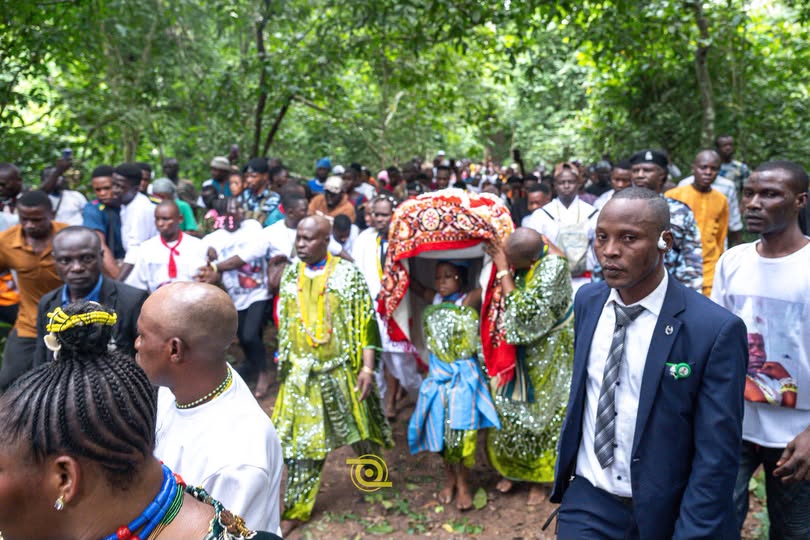 Each stage moves the community closer to the festival’s climax, from cleansing to illumination, from remembrance to procession, from sacrifice to prayer and finally to renewal. The Arugba takes her central place at the point where the community moves physically toward the sacred grove, accompanied by drumming, dancing, traditional costume, Yoruba-language expression and praise poetry. At the grove itself, she takes part in a ritual that the Commission describes as a reenactment of the first meeting between the founding tradition of Osogbo and Yeye Osun. The community is not merely retelling an old story on that day. It is performing its own historical memory.
The Ataoja and the Arugba
The presence of the Ataoja alongside the Arugba carries its own meaning. The Ataoja represents the traditional kingship of Osogbo, while the Arugba represents the votary institution through which the sacred offering is carried. Neither figure replaces the other. They occupy different positions within the same ritual structure, and together they connect the palace, the community and the sacred grove.
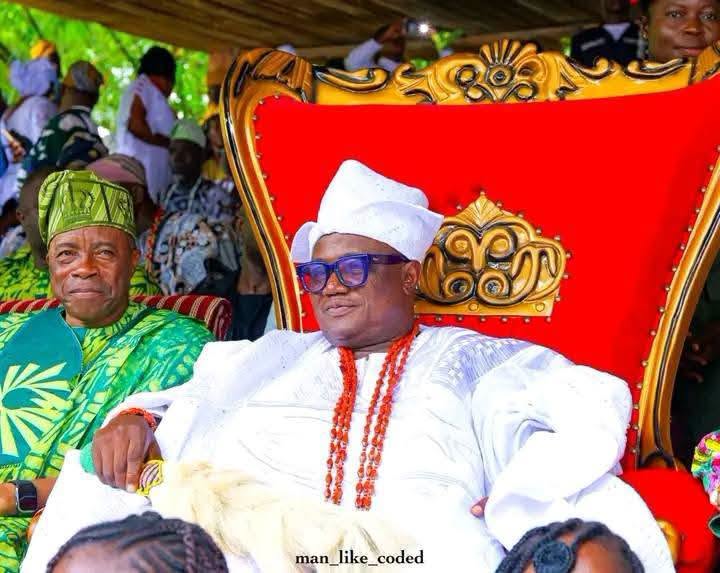 This relationship is one reason the festival should not be read simply as a religious ceremony detached from the history of Osogbo’s political institution. It is, at the same time, a celebration of ancestry, kingship, community and spiritual continuity.
Why a young woman?
The identity of the Arugba as a young woman has drawn considerable academic interest. Traditional accounts emphasise her purity and her ritual suitability. The National Institute for Cultural Orientation’s historical account describes the Arugba as a virgin whose purity matters to the ritual, though this should not be read through the misleading language of “virgin sacrifice.” The Arugba is not herself the sacrifice. She is the votary carrier of the ritual offering, and her selection and preparation belong to a longstanding system of ritual responsibility. The distinction matters.
Her role also raises questions about female authority within Yoruba cultural imagination.
Rotimi Fasan, in a peer-reviewed study published in the Journal of African Cultural Studies, examined the Arugba through field observation of the 2012 and 2015 Osun-Osogbo festivals and through an analysis of Tunde Kelani’s 2008 film Arugba. Fasan reads the figure as a representation of female power, independence, leadership and spiritual agency, which makes the Arugba considerably more than a ritual participant. She becomes, in this reading, a powerful cultural symbol in her own right.
A woman at the centre of a sacred institution
There is something striking about the position the Arugba occupies. She is young and female, she carries a sacred object, and she leads a major section of the ritual procession while the king walks beside her and priests and priestesses surround her. Thousands watch her journey, and her movement is treated with genuine ritual seriousness.
Her authority does not come from political office. It comes from the sacred responsibility placed in her hands, which is especially significant when set beside Osun herself, long represented in Yoruba religious thought as a powerful feminine spiritual force. The Arugba operates within that same wider cultural vocabulary, one in which femininity can carry associations of fertility, creativity, protection, spiritual power, healing and social renewal.
Arugba as a bridge between generations
Perhaps the most important dimension of the Arugba’s role is cultural transmission. A young woman carries a tradition inherited from generations before her. She performs a
ritual older than her own lifetime, follows a route laid down by earlier generations, and enters a sacred landscape that has outlasted decades of urban expansion and social change. The meaning of her role reaches her through oral tradition, ritual practice and community memory.
In that sense, the Arugba represents continuity even as everything around her changes.
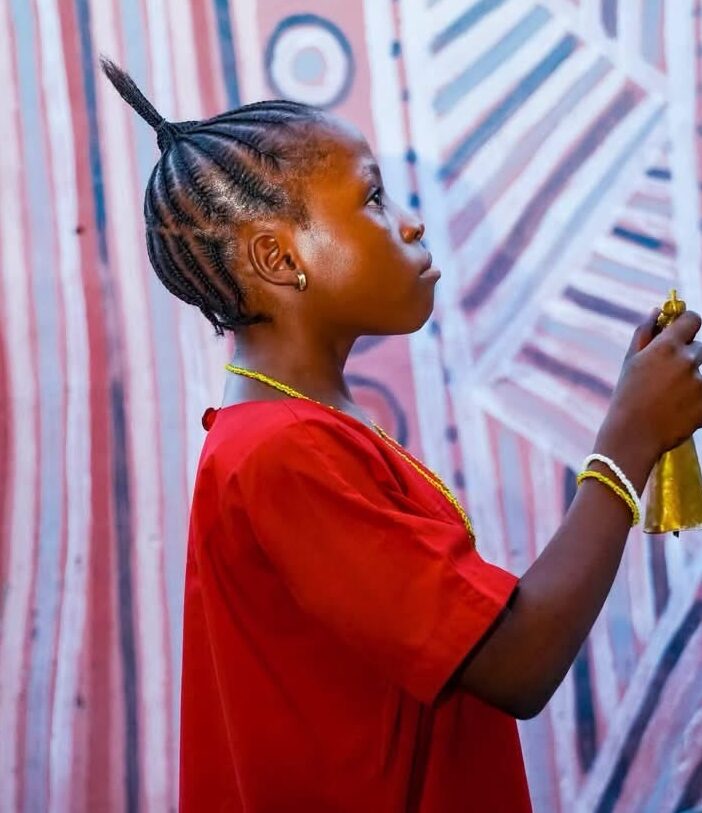 The person holding the role changes with each generation, but the office itself remains. This is close to what UNESCO means when it describes the Osun-Osogbo Grove as a living cultural landscape rather than an archaeological remnant. Its significance rests partly on the fact that its shrines, sculptures, river, forest and rituals remain bound up with contemporary Yoruba religious and cultural life, rather than preserved behind glass.
The Sacred Grove as a cultural archive
The forest itself deserves as much attention as the festival it hosts. Before modern urbanisation, sacred groves stood beside many Yoruba settlements. Most have since disappeared or been substantially reduced, but the Osun-Osogbo Grove survived, and the National Commission for Museums and Monuments identifies it as one of the last surviving forests of this kind. The Commission records that the grove covers roughly 75 hectares and remains protected from farming, hunting and fishing.
 The result is a site that functions at once as an ecological environment, a spiritual landscape, an artistic environment and a historical archive. Its trees, river, shrines, sculptures, rituals and oral traditions are not separable elements laid side by side. They form a single system, and removing any one of them weakens the meaning of the whole. Preserving Osun-Osogbo cannot mean preserving its sculptures alone. The living cultural system around them has to survive too.
Susanne Wenger and the modern preservation of Osun-Osogbo
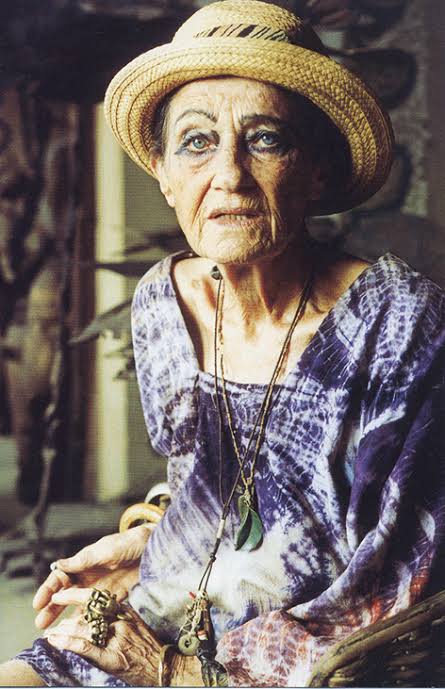
Any serious account of the modern Osun-Osogbo Sacred Grove has to acknowledge Susanne Wenger, the Austrian-born artist who became deeply involved in Yoruba religious and artistic tradition and was known within the community as Adunni Olorisa. Her contribution matters to the site’s modern preservation history, but the chronology should be stated plainly. Wenger did not create the Osun tradition. The grove, its religious practices and its relationship with the Osogbo community existed long before her arrival. Her significance lies in the artistic revitalisation work she carried out with Yoruba artists and custodians in the twentieth century, and UNESCO recognises the New Sacred Art movement associated with Wenger and Osogbo’s artists as an important example of cultural interaction and artistic renewal.
Her legacy belongs, accordingly, to the modern history of preservation, while the underlying heritage remains Yoruba. The distinction is worth stating clearly, because African heritage is best documented in ways that acknowledge outside contributors without letting them stand in for the communities that created, sustained and passed the tradition down.
From sacred tradition to World Heritage
The international recognition of Osun-Osogbo marks an important moment in the history of African heritage preservation. The site was declared a Nigerian National Monument on 5 August 1965 and inscribed on the UNESCO World Heritage List on 15 July 2005. The
National Commission for Museums and Monuments identifies it as Nigeria’s second World Heritage Site and classifies it as a cultural landscape, a status that places Osun-Osogbo within a much larger conversation about how indigenous African knowledge systems are preserved and understood.
For much of the colonial period, African religious landscapes were often described from the outside through categories that misread or dismissed their intellectual and spiritual depth. Osun-Osogbo challenges that inherited framing. The grove shows that an African forest can serve simultaneously as a place of worship, an ecological environment, a centre of artistic expression, a repository of historical memory and a site of community identity.
Arugba and the African diaspora
The significance of Osun-Osogbo does not stop at the boundaries of Osun State. The festival has become an important point of cultural reference for Yoruba people and people of Yoruba descent around the world, and the National Commission for Museums and Monuments explicitly names the grove as a key reference point for Yoruba identity and the wider Yoruba diaspora.

This matters because Yoruba religious and cultural traditions travelled across the Atlantic through the history of the African diaspora, and elements of Yoruba spirituality survived and developed in new forms in Brazil, Cuba, the Caribbean and other parts of the Americas, where Osun is known under different names within several of these traditions. OsunOsogbo occupies a distinct place within that story, because it remains a physical homeland where a living Yoruba sacred landscape can still be encountered directly, rather than only reconstructed from memory. For members of the diaspora, that difference carries real weight.
Tourism must come with cultural responsibility
The growing international attention around Osun-Osogbo is an opportunity for Nigeria, and also a responsibility. The festival draws worshippers, researchers, photographers and cultural tourists from across Nigeria and beyond, and the National Commission for Museums and Monuments identifies tourism as one of the festival’s benefits while also documenting the environmental and land-use pressures building around the grove.

The task ahead is to keep tourism from consuming the very culture that draws visitors to it. A sacred ritual should not be flattened into spectacle. The Arugba should not become simply a photographic subject, and the grove should not be treated as a beautiful forest stripped of its spiritual context. Responsible cultural tourism depends on listening to the custodians of the tradition, on historical accuracy, on respect for sacred space, on careful documentation and on the involvement of the local community. Above all, it depends on understanding coming before consumption.
The preservation of Arugba is the preservation of knowledge
The future of the Arugba tradition depends on more than finding a young woman to carry the calabash each year. The harder question is whether future generations will understand what that act means: whether they will know the history behind it, the relationship between Osun and Osogbo, the significance of the sacred grove, the role of the Ataoja, the living body of Yoruba praise poetry and the traditional names that carry meaning within it. It depends on whether young people learn to distinguish cultural performance from sacred ritual, on whether researchers document the oral tradition responsibly, and on whether tourism continues to respect the sacred character of the site.
 These are preservation questions in the fullest sense. The physical figure of the Arugba can go on being chosen every year while the knowledge surrounding her quietly disappears, and that outcome would amount to preserving the image while losing the heritage it represents. The real objective has to be cultural continuity, not just ceremonial repetition.
Arugba in contemporary Yoruba identity
In a Nigeria reshaped continually by urbanisation, migration, technology and changing religious practice, institutions such as the Arugba matter more, not less. They offer a connection to ancestral memory and give younger generations a physical encounter with their own cultural inheritance, a space where Yoruba language, music, dress, poetry, ritual and history continue to meet.
 They also show that tradition does not require cultural stagnation. The Osun-Osogbo Festival has changed considerably in presentation and scale over the decades, and it now exists within a world of international tourism, digital media, photography, documentary film and global cultural exchange. Yet its central ritual structure remains recognisable across all of that change, which is the nature of living heritage. It adapts without losing its identity.
The Arugba is more than an image
In an age of social media, it is easy for the Arugba to be reduced to an image: a photograph, a costume, a headline, a tourist attraction, a symbol lifted for promotional material. The history behind that image deserves more careful attention than that.
 The Arugba carries a calabash. The calabash carries an offering. The offering carries the community’s prayers, and the procession carries the memory of the ancestors into the sacred landscape of the grove, where the festival renews the continuing relationship between Osogbo and Osun. This is why the Arugba still matters. She is not simply a part of the Osun-Osogbo Festival. She is one of the living mechanisms through which the festival communicates its deepest meaning.
A heritage worth understanding
The Osun-Osogbo Sacred Grove stands as one of Nigeria’s most important examples of living indigenous heritage, and its significance lies precisely in the fact that it has not been frozen in the past. The forest remains, the river remains, the shrines remain and the festival remains. The Ataoja still takes his place within the ritual structure, the Arugba still carries the calabash, and every year a new generation meets an old tradition face to face.
 That is the real historical significance of the Arugba. She represents the ability of a people to carry their memory forward, and she is a reminder that heritage does not live only behind museum glass. Sometimes it walks. Sometimes it sings, dances, and enters a sacred forest carrying a calabash, and through that simple journey, an entire people tells the world something plain and enduring: we remember where we came from, we still know who we are, and we intend to carry the memory forward.