


Home Blog Page 185

The man behind Africa’s biggest telco

Ralph Tendai Mupita is one of Africa’s most experienced and respected telecoms executives, serving as MTN President and Group CEO since September 2020.
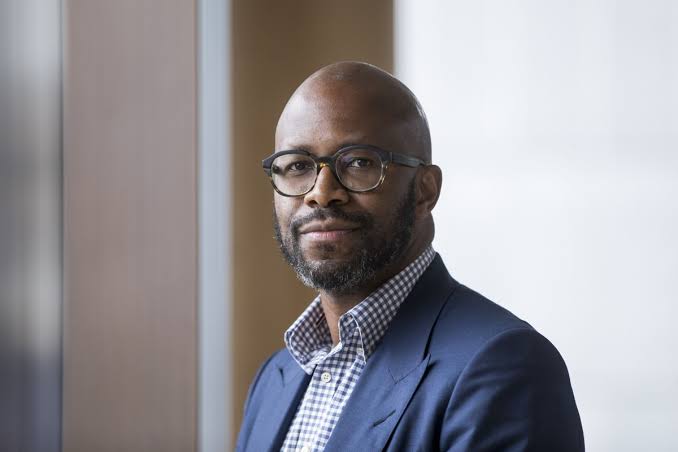
However, unlike many of his peers, Mupita had only been at the company he now leads for a relatively short period before taking the reigns.


His journey to the top of Africa’s biggest telecoms company started in a completely different field — civil engineering.


Mupita was born in Goromonzi, Zimbabwe, on 11 April 1972 and grew up in the small town of Mutare.


In a YouTube interview with Dr Nik Eberl, Mupita said his dream career as a child was to go to the Moon.


Mupita’s father was a teacher, and his mother a nurse, which meant that money was a slight impediment to such a grand ambition.


“I wanted to be an astronaut. But sometime when I was about ten or eleven years old, someone told me ‘No, Africans don’t go to the moon’,” Mupita said. “It was hard to listen to that person, but I did, and here I am today.”


In a subsequent interview, Mupita explained that the tough conversation made him think about the impact of limited means on people growing up in small towns.


That ultimately made him more curious about what was possible if a person tried to push the boundaries.


Mupita said he did not grow up with a TV in the house, but he and his siblings had plenty of books to read, which sat well with his father’s view that education was of critical importance.


However, he also enjoyed sports, performing well in athletics and obtaining national school colours for Zimbabwean cricket while also performing well in athletics.


His sports skills afforded him scholarships through middle school and high school, which were completed at Churchill School and Plumtree School, respectively.


Studies and career in South Africa


University of Cape Town

Mupita’s time in South Africa began with his studies for a Bachelor of Science degree in civil engineering at the University of Cape Town (UCT).


Initially, he had no plans to come to the country and wanted to venture into academics in the United Kingdom.


A girl he was very interested in said she was coming to South Africa, which encouraged him to make the move.


“I kind of abandoned the idea to follow her. But she never rocks up in South Africa,” he laughed.


The decision to study civil engineering was partially because two of his uncles had also worked in the field.


His parents did not have money to pay for his education, but he studied through a scholarship from Haw & Inglis.


After obtaining his qualification, Mupita worked as a staff civil engineer at the company in Cape Town from 1996 to 1999.


Towards the end of that time, he began itching to move on and try something that would challenge him in a new space of “discomfort”.


“I was feeling the learning curve was flattening,” Mupita said. “I operate best when there is an edge, a bit of tension, and a little bit of uncertainty in myself.”


“When I feel too sure [of myself], I think it’s a very dangerous place, because you get hubris and you make assumptions and errors.”


His time at the firm taught him one important thing he wanted to continue doing — problem-solving.


He returned to UCT to study a Master of Business Administration in 2000, with a scholarship from Old Mutual.


In 2001, Mupita joined the company, where he would go on to serve in various senior roles — including Director of Strategy and Director of Retail for High Net-worth & Affluent customers.


In February 2012, he was appointed as the Old Mutual Emerging Markets CEO, a position he held until January 2017.


Three months later, he began his career at MTN Group as chief financial officer.


That offer came during a coffee with MTN executive chairman at the time, Phuthuma Nhleko.


Mupita was not certain about the proposition as he had little experience in telecoms and did not have the traditional qualifications.


As was the case when he left civil engineering, Mupita again saw an opportunity to learn.


“I don’t think I was a brilliant technical CFO, probably was a very bad one,” Mupita said.


“But I think I brought the disciplines of capital management and finance strategy because I played strategy roles before.”


Mupita won several CFO awards while serving as MTN’s financial boss

He would serve in this capacity until August 2020, when he replaced Rob Shuter as MTN Group CEO.


In recent years, Mupita has guided MTN through significant challenges in its two biggest markets, Nigeria and South Africa.


In Nigeria, the company’s finances have been hard-hit by the devaluation of the Naira and run-ins with egregious tax claims.


In South Africa, load-shedding and little economic growth have negatively impacted MTN and other mobile networks.


Mupita believes that mobile networks need to reinvent themselves in two ways.


Firstly, they should see their connectivity as a more open platform for other companies to run their services, similar to how fibre network operators sell their capacity to Internet service providers.


Secondly, Mupita believes mobile networks should see themselves as part of the ecosystem of online services like streaming and should leverage their large subscribers to reach customers with their own offerings.

Chinese Construction Company, CCECC Pays Nigerian Workers In Niger State Meagre N1,250 As Daily Wage Despite Harsh Working Conditions

0

According to several workers who spoke to SaharaReporters on condition of anonymity, they are paid a daily wage of N1,250, equivalent to N125 per hour. However, this wage, they claim, barely covers their daily expenses, including meals and transportation to and from work.


Casual workers also known as labourers employed by the China Civil Engineering Construction Corporation (CCECC) in Minna, Niger State, have raised concerns over what they described as inadequate payment and unfavourable working conditions while working on road construction projects in the capital city.


According to several workers who spoke to SaharaReporters on condition of anonymity, they are paid a daily wage of N1,250, equivalent to N125 per hour. However, this wage, they claim, barely covers their daily expenses, including meals and transportation to and from work.


“We receive N1,250 per day, but after spending N600 on transportation and another N600 on meals, there’s little left to support our families,” lamented one worker. “It’s as if we are working just to survive day-to-day.”


The workers also expressed frustration at the deductions imposed by CCECC management.


“If we arrive late, they deduct N100 from our already meagre pay,” explained another worker. “And despite the agreed hours of 9 am to 6 pm, we often end up working until 6:30 pm without any additional compensation.”


The harsh working conditions and low pay have taken a toll on the morale among the workers.


“We’re not even given a risk allowance, despite the dangers we face on the job,” said a labourer. “I’m only doing this because I have no other choice in Nigeria’s tough economic situation. But the stress and the conditions are unbearable.”


Efforts made by SaharaReporters to get CCECC management through the company mobile phone number displayed on its website were unsuccessful.


In March 2024, it was reported that Nigeria had secured $1.3 billion in funding to complete a railway project connecting Kano, the largest city in the north, to Maradi in neighbouring Niger.


The transport ministry in a statement said funding would come from a consortium led by the CCECC, which would contribute 85% of the total.


The remaining 15% will be covered by the Nigerian government alongside institutions like the Africa Export-Import Bank and African Development Bank.


“The securing of $1.3 billion signifies a monumental step forward in the completion of this critical infrastructure,” transport ministry spokesperson Jamilu Ja’afaru said.


The railway line aims to enhance economic and cultural exchange by strengthening the existing bonds between the two nations, thereby fostering increased trade and cooperation in various fields.


Credit: Sahara Reporter

Chinese Construction Company, CCECC Pays Nigerian Workers In Niger State Meagre N1,250 As Daily Wage Despite Harsh Working Conditions

0

Chinese Construction Company, CCECC Pays Nigerian Workers In Niger State Meagre N1,250 As Daily Wage Despite Harsh Working Conditions

photo

July 5, 2024

According to several workers who spoke to SaharaReporters on condition of anonymity, they are paid a daily wage of N1,250, equivalent to N125 per hour. However, this wage, they claim, barely covers their daily expenses, including meals and transportation to and from work.


Casual workers also known as labourers employed by the China Civil Engineering Construction Corporation (CCECC) in Minna, Niger State, have raised concerns over what they described as inadequate payment and unfavourable working conditions while working on road construction projects in the capital city.


According to several workers who spoke to SaharaReporters on condition of anonymity, they are paid a daily wage of N1,250, equivalent to N125 per hour. However, this wage, they claim, barely covers their daily expenses, including meals and transportation to and from work.


“We receive N1,250 per day, but after spending N600 on transportation and another N600 on meals, there’s little left to support our families,” lamented one worker. “It’s as if we are working just to survive day-to-day.”


The workers also expressed frustration at the deductions imposed by CCECC management.


“If we arrive late, they deduct N100 from our already meagre pay,” explained another worker. “And despite the agreed hours of 9 am to 6 pm, we often end up working until 6:30 pm without any additional compensation.”


The harsh working conditions and low pay have taken a toll on the morale among the workers.


“We’re not even given a risk allowance, despite the dangers we face on the job,” said a labourer. “I’m only doing this because I have no other choice in Nigeria’s tough economic situation. But the stress and the conditions are unbearable.”


Efforts made by SaharaReporters to get CCECC management through the company mobile phone number displayed on its website were unsuccessful.


In March 2024, it was reported that Nigeria had secured $1.3 billion in funding to complete a railway project connecting Kano, the largest city in the north, to Maradi in neighbouring Niger.


The transport ministry in a statement said funding would come from a consortium led by the CCECC, which would contribute 85% of the total.


The remaining 15% will be covered by the Nigerian government alongside institutions like the Africa Export-Import Bank and African Development Bank.


“The securing of $1.3 billion signifies a monumental step forward in the completion of this critical infrastructure,” transport ministry spokesperson Jamilu Ja’afaru said.


The railway line aims to enhance economic and cultural exchange by strengthening the existing bonds between the two nations, thereby fostering increased trade and cooperation in various fields.

From boardroom to Nollywood: My amazing journey — Ogochukwu Ekezie

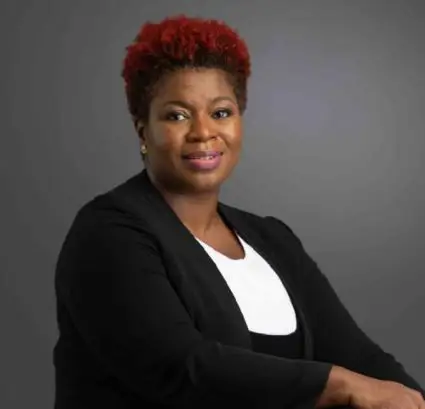
Walking out of the boardroom and venturing into the world of film making, Ogochukwu Ekezie does not look like an amateur in the entertainment industry. For anything, she’s as good as the legends of the industry.


In fact, since the premiere of her debut short movie, “Were” at the New York African Film Festival., the effervescent female movie producer and former Corporate executive has been brandishing uncommon knowledge in the area of storytelling.


Ogochukwu is a gifted storyteller and creative. Prior to venturing into Nollywood and founding Red Sand Studios, she spent part of flourishing career as a business executive and CMO telling brand stories through award winning ad campaigns that delivered results.


Upon relocating to Nigeria from the US more than 20 years ago, Ogochukwu, with two bachelors degree in Journalism and Criminology in her kits, started her journey in the corporate world in Nigeria as a brand manager at ARM Investment Managers before moving to other brands.


Sharing her amazing journey in a recent chat with our reporter, Ogochukwu said : “I moved to Citi Bank as a Public Affairs Officer for Nigeria and Ghana. Thereafter, I moved to Union Bank as the Chief marketing officer.”


Despite her success story in the corporate world, Ogochukwu didn’t feel fulfilled. She would recall that even before she moved back to the country, her dream was to join the movie industry from the start.


“I had told my parents I wanted to come to Nigeria and open up movie theatres. And as true Nigerian parents would react, they had said nobody goes to the cinemas in Nigeria. Six months after I moved back to Nigeria, Silverbird Cinemas opened. I am a great lover of films. When I was much younger, I would go to the movie theatres alone and watch movies.”


More than 20 years later, Ogocukwu said it was time she pursued her dream in storytelling craft.


“Nollywood has made a giant stride in the last two decades. I feel this is the right time for me to execute this dream and vision that I have had. I would describe my journey from the Boardroom to Nollywood as an amazing one.”


Ogochukwu is determined to carve a niche for herself in Nollywood despite the odds.


She said that her mission in the industry is to elevate African storytelling through movies that not only entertain but also stir the conscience.


Her movie, “Were, written and directed by Dolapo Marinho and starring Belinda Yanga, focuses on the mental health issues in Lagos and the experiences of the most marginalized people living on the edge of our society.


“’Were’ is an interesting movie. It is culled from a story – Under the Bridge- and we took the central character and turned it into a short film. The story is about a mentally ill woman who lives at the top of Ojota Bridge and relies on the generosity of a stranger who comes to feed her every day. When the stranger disappears, she comes out of her shack and mingles with the world. The three days she comes out to fend for herself, a series of things happen to her. The movie features Belinda Yanga as the lead actor,” Ogochukwu added.


*Lagos State Government Clears Pension Backlog, Pays ₦4.5 Billion to 2,000 Retirees

0

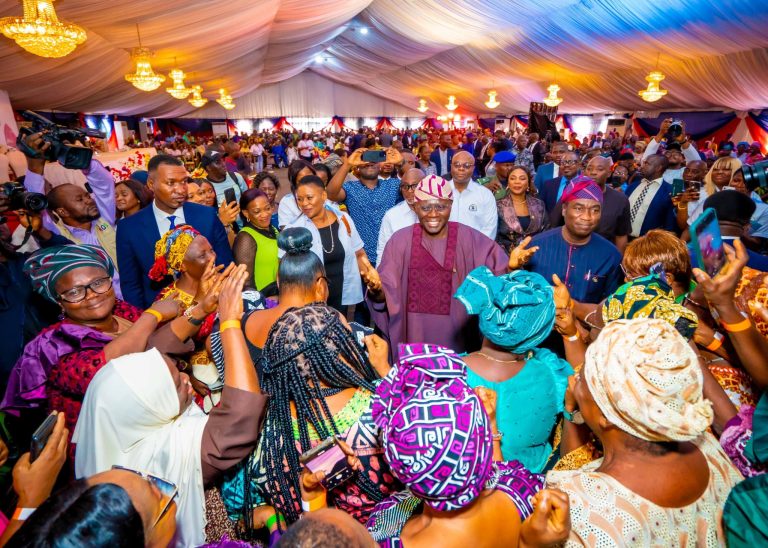
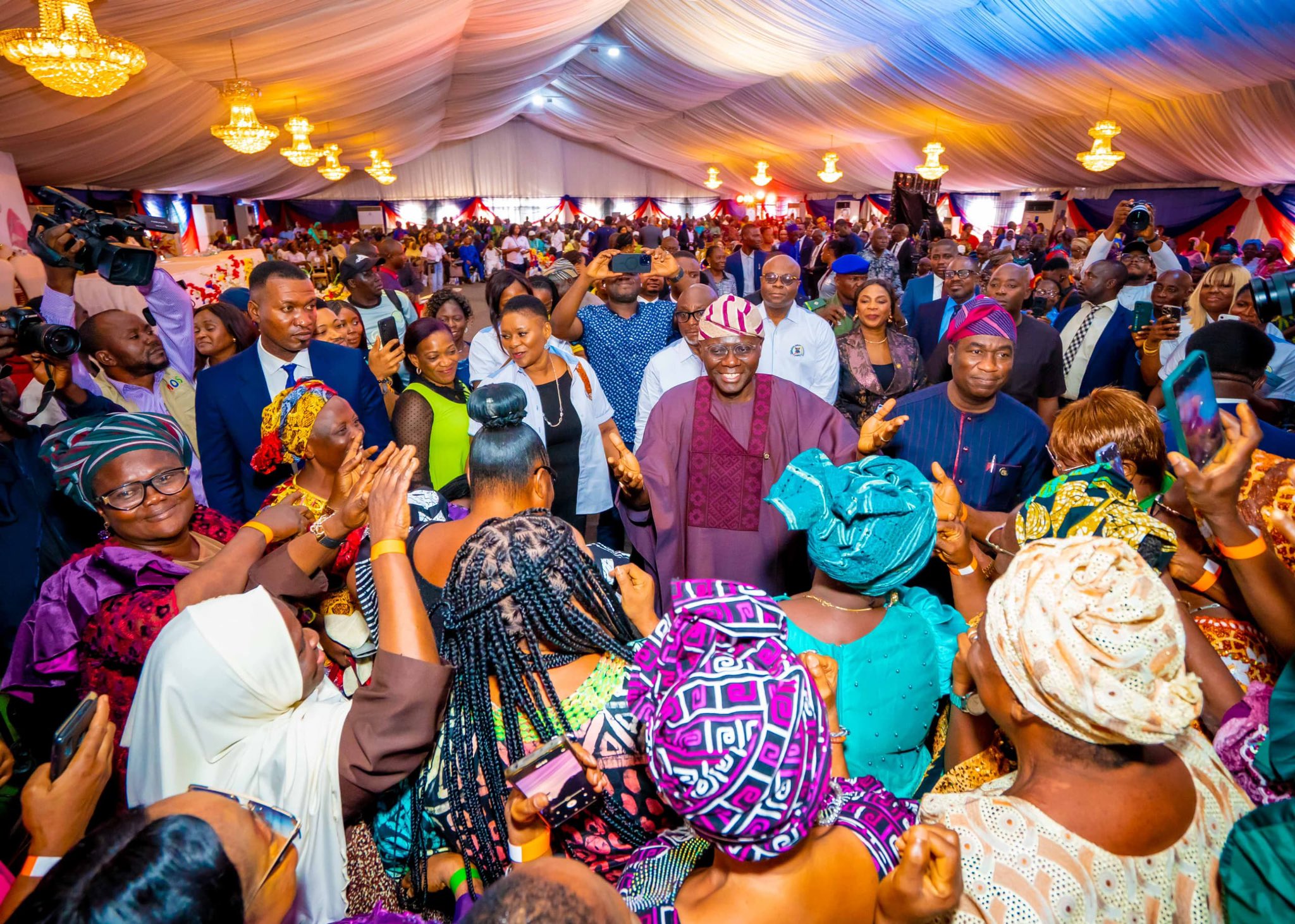
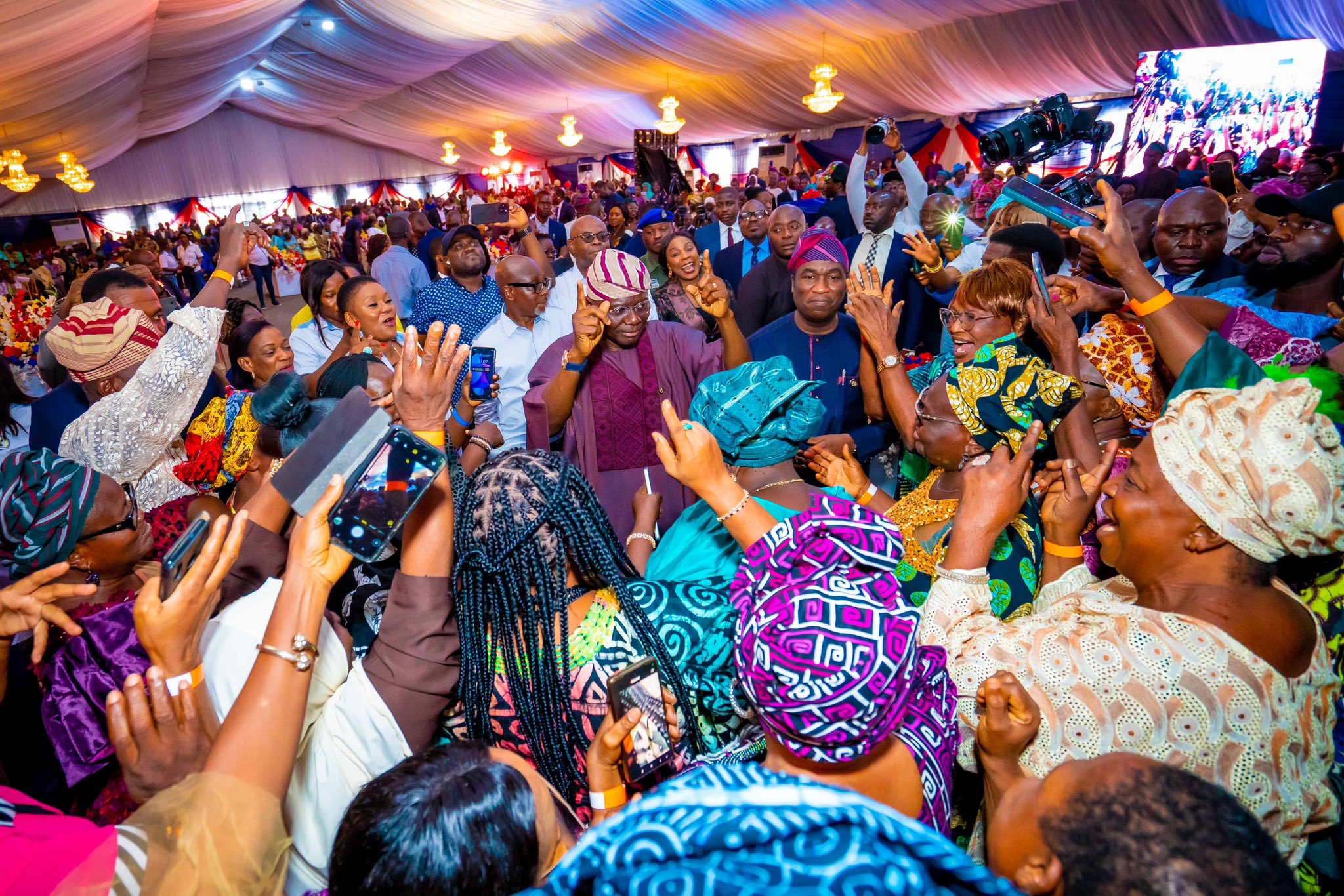
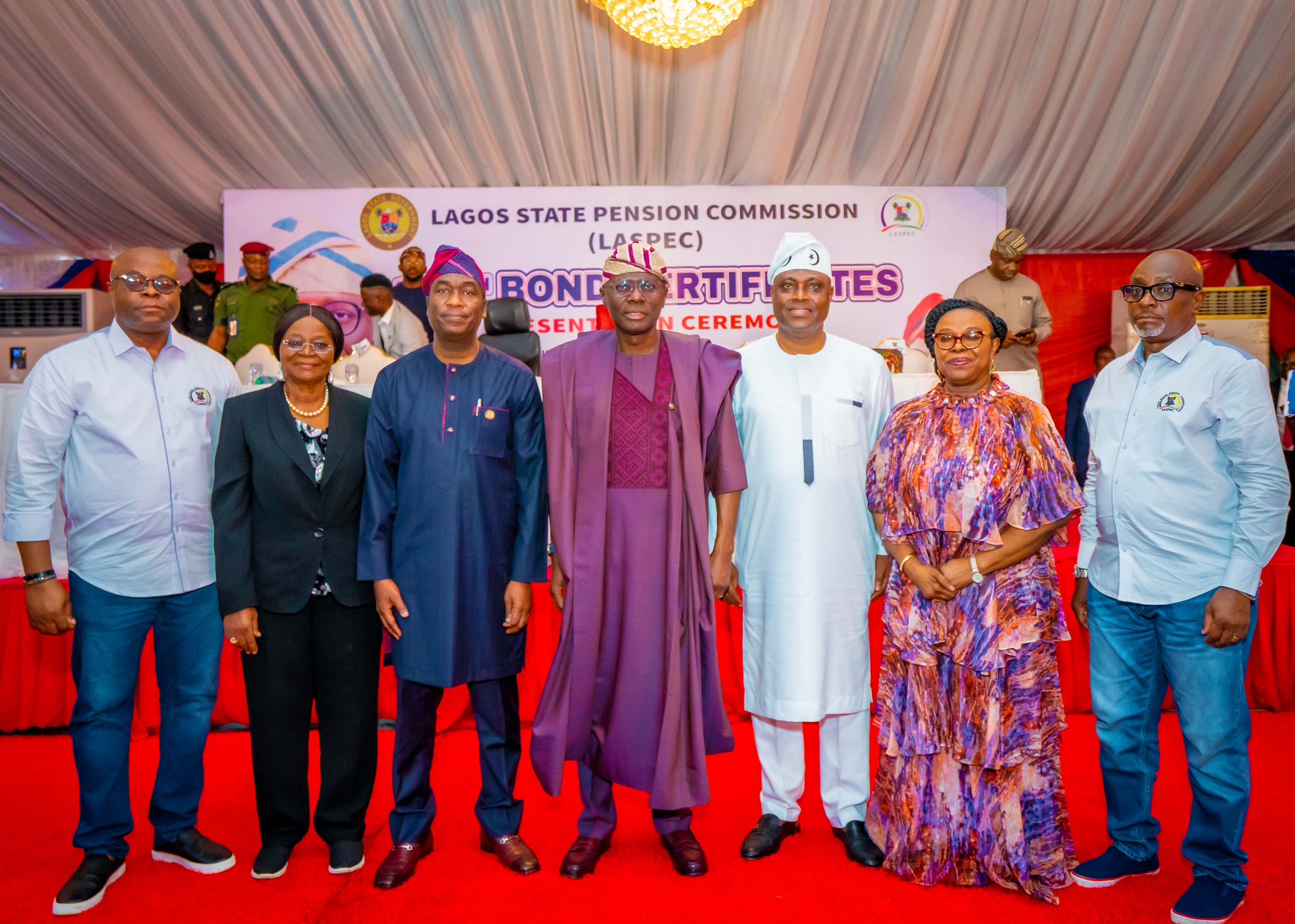
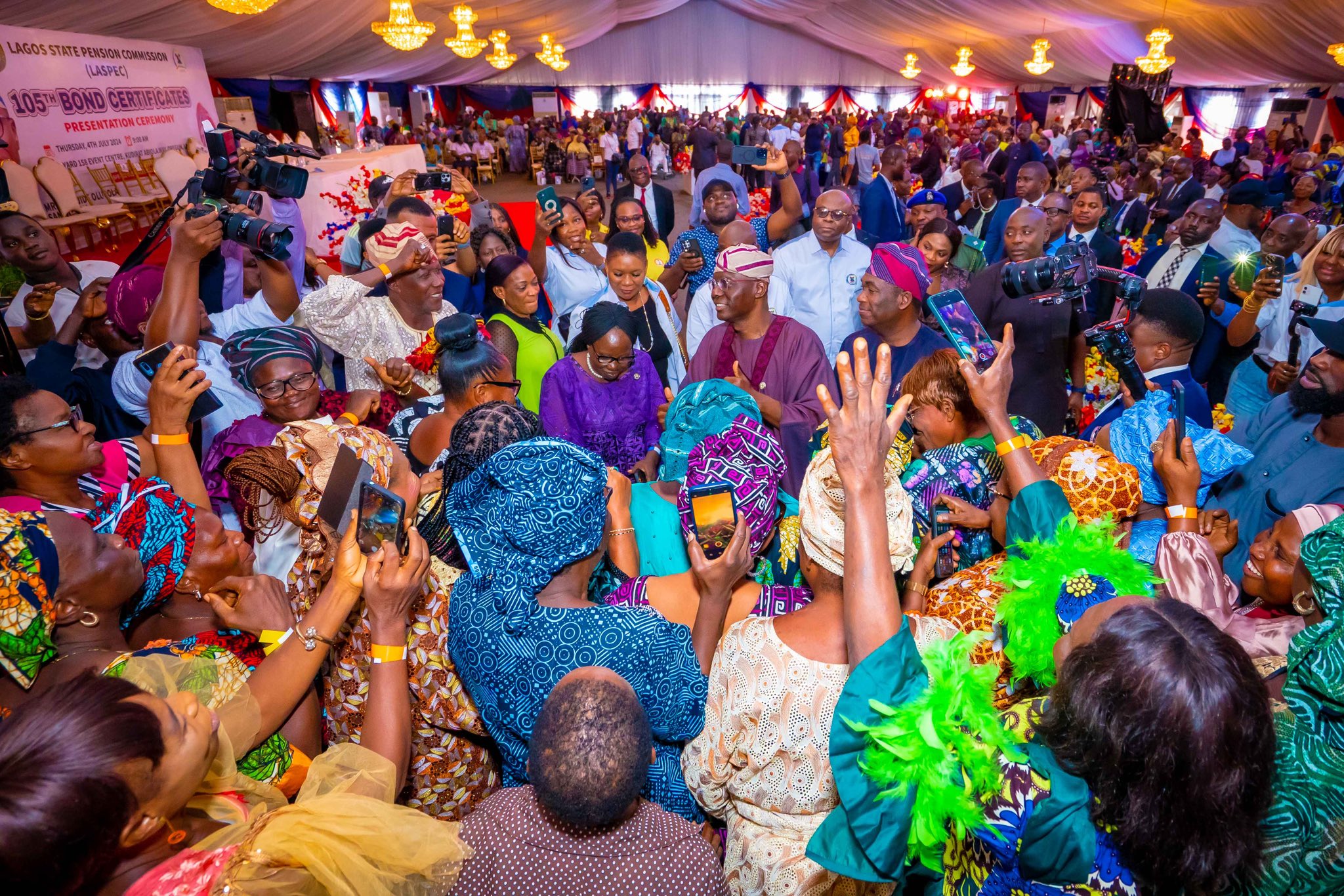
The Lagos State Government has achieved a significant milestone in pension benefits administration, clearing all pension backlog with the payment of ₦4,461,659,536.82 to 2,000 retirees. This payment fulfills the promise made in February to settle all arrears and current pension liabilities.

Since its inception, the administration has paid a total of ₦68,164,627,407.21 into the Retirement Savings Accounts (RSAs) of retirees across various sectors, including mainstream, local government, SUBEB, TESCOM, and parastatals.

This achievement ensures that employees who retire from the civil service will receive their full pension benefits and gratuity immediately after retirement, solidifying Lagos State’s lead in pension benefits administration with a “Pay As You Go” template.

In addition, the state government launched a Health Insurance Scheme specifically designed for retirees, providing access to a wide range of medical services.

The Governor commended the DG of the Lagos State Pension Commission, Mr. Babalola Obilana, and his team for their dedication and professionalism in achieving this milestone.


This development demonstrates the state government’s commitment to prioritizing the welfare of retired workers and enhancing their lives in retirement.

Sanwo-Olu to establish Lagos state sovereign investment fund, lobbies NSIA to invest in Lekki airport project 

0

The Lagos State Governor, Mr Babajide Sanwo-Olu, announced on Wednesday that the state plans to establish a Sovereign Investment Fund for strategic future investments.


Governor Sanwo-Olu made this statement during a courtesy visit by the Executive Management of the Nigeria Sovereign Investment Authority (NSIA), led by its Managing Director/CEO, Aminu Umar-Sadiq, at Lagos House, Marina.


The Governor urged the Nigeria Sovereign Investment Authority to consider investing in Lagos State Government projects, including the Lekki Airport, Rail, Film City, and Food Logistics Hub.


What he said, “We, as a subnational, are planning to set up a Sovereign Investment Fund and it is not out of place because we also realised that the Sovereign Fund is critical. It is critical because you can starve yourself a little bit to provide for the future by setting something aside for the future. I think it is always a prudent thing to do. It is not out of place for subnationals to have funds working for today and for the future.”


“I am aware you (NSIA) have a massive oncology centre in LUTH (Lagos University Teaching Hospital). We believe Lagos actually requires about four or five of such facilities across the state. So, we as a government are planning to support another investor to set up another one so that we can have a way to meet the growing needs of our citizens to reverse medical tourism.”


“In Lagos, we pride ourselves on being able to do more if we can get the resources to work with. We have an airport project that we have conceived and are pushing to get financial closure. You can take on the project. We have a Film City in Lagos, which is a massive entertainment city that we are planning to build. It is the future of the creative industry. These are investments we have in Lagos you might look at.”


NSIA generates N1.6 trillion income

Earlier, Umar-Sadiq explained that the NSIA is a legally established institution responsible for managing funds for the benefit of future generations of Nigerians.


He revealed that last year, the fund achieved a total comprehensive income of approximately N1.6 trillion and core earnings of N200 billion.


Umar-Sadiq stated that the NSIA would continue to position itself as the preferred asset manager for both the federal and state governments in Nigeria.


He mentioned that the NSIA would remain available for use by government actors at both levels and emphasized leveraging their services for the benefit of the Center of Excellence.


LAWMA: Lagos set to close Olusosun dump

0

Lagos set to close Olusosun dump


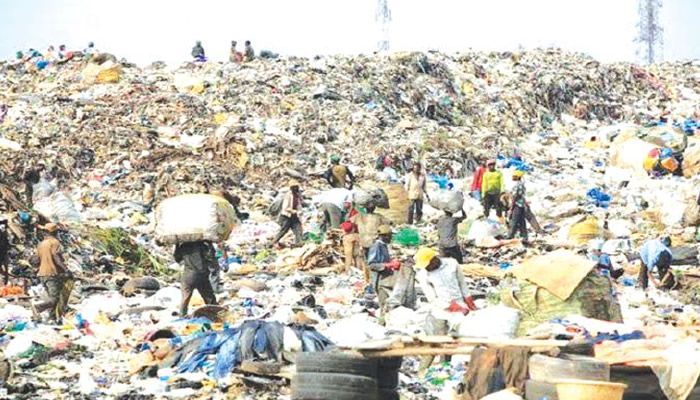
The Lagos Waste Management Authority has revealed that the state government has made significant plans to decommission the Olusosun dumpsite located in the Ojota area, noting that it is a major move aimed at addressing the longstanding environmental and health concerns associated with the site.


This was disclosed to our correspondent by the Director of Public Affairs, LAWMA, Sade Kadiri, in a chat on Monday.


Kadiri said the decommissioning would pave the way for advanced waste treatment initiatives that were expected to transform waste management in Lagos.


According to her, the authority was shifting focus towards sustainable waste management solutions and a broader strategy to transform waste management in the state to reduce reliance on traditional dumpsite.


She said, “Looking ahead, we have significant plans for the Olusosun dumpsite. The site is slated for decommissioning and will be repurposed for an advanced waste treatment initiative.


“Our plans include the development of Waste-to-Wealth programmes, Waste-to-Energy projects, and organic waste composting facilities.”


Kadiri highlighted that LAWMA’s strategy was bolstered by recent partnerships aimed at bringing expertise and innovative solutions to Lagos.


She said the agency had signed a Memorandum of Understanding with the JOSPONG Group and Harvest Waste, both recognised for their work in sustainable waste treatment while several other companies had expressed interest and were submitting proposals to support LAWMA’s ambitious goals.


“LAWMA is not only focused on long-term waste management solutions but is also taking immediate steps to safeguard public health,” she said.


She also reiterated that no cholera case had been recorded at the Olusosun site or any other designated disposal facilities across the state. However, she said that to mitigate potential risks, LAWMA had initiated comprehensive sensitisation programmes for its operatives and waste pickers, emphasising the importance of good hygiene and sanitary conditions.


“We recently began a sensitisation campaign on social media and our advocacy team has been going around the city sensitising and educating residents to preventive measures to adopt against the cholera scourge, which among others include hand-washing after handling refuse, bagging and containerisation of waste, shunning indiscriminate dumping, and patronising only accredited waste disposal companies (PSP Operators).


Journey into royalty: 12 things you didn’t know about the Ọọni of Ifẹ

Kings are born, not made. While anyone can aspire to be a president, a king’s path is predestined.


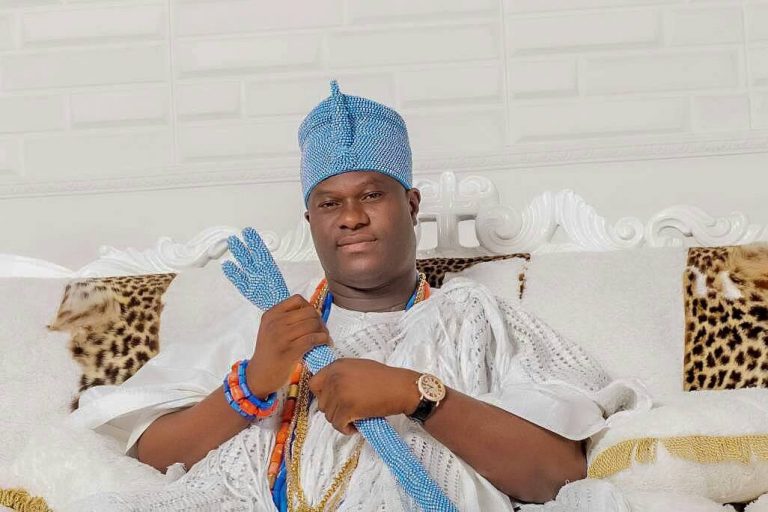
For Oba Adeyeye Enitan Ogunwusi CFR, the 51st and current Ooni of Ife, becoming a king was a destiny fulfilled, not a position achieved through aspiration. As the traditional ruler of the Yoruba kingdom of Ile-Ife, he ascended to the throne in 2015, following the passing of Oba Okunade Sijuwade, the 50th Ooni of Ife.


“It was foretold even before I was born, so my upbringing was closely guarded,” Oba Ogunwusi shared in an interview with BD Weekender. “In youth, we often make mistakes and face challenges, but in every negative situation, God has turned it into positivity for me.”


Here are some lesser-known facts about Oba Adeyeye, the Ooni of Ife:

Project 50-50


Oba Adeyeye, approaching his 50th birthday in October 2024, aims to celebrate it with 50 iconic projects across various sectors. From health and education to fashion and entertainment, these initiatives, including an advanced health facility, are designed to profoundly impact society.


“Turning 50 is more than just a milestone; it’s about celebrating the impactful work we’ve done,” Oba Adeyeye remarked. “Few knew of my efforts before I became Ooni of Ife, but in the nine years since, God has enabled me to establish numerous significant projects worldwide. I want to showcase these to prove that you can be on a throne and still make a substantial impact.”


Highlighting the breadth of his initiatives, he added, “My projects have touched various strata, crossing different races, ethnicities, and even religious beliefs. I hope that by showcasing them, people will gain a better understanding of who I am.”


King Ogunwusi doesn’t feel 50


Although Ọọni Adeyeye will turn 50 in four months, he doesn’t feel his age. When asked about it, he said, “Well, no, I don’t. To me, age is just a number. Traditionally, I shouldn’t celebrate my birthday on the throne but rather celebrate my days on the throne as a father to all, both young and old.


“But due to my advocacy for youth, I do. “I use these moments to inspire the youth, to show them that they can achieve great things,” he added.


Champion of African Fashion


In addition to his role as a traditional ruler, Oba Adeyeye has significantly contributed to the global promotion of African fashion. For over a decade, he has been a key sponsor of African Fashion Week in London and Nigeria, advocating for the global recognition of Nigerian-made fashion.


The 2024 edition of African Fashion Week is themed “Traditional Fabrics and Royal Regalia.” The Ọọni highlighted the importance of the event, noting, “It’s a strong brand driven by passion and dedication, particularly by my queen, Olori Aderonke, who has been instrumental in the success of this initiative.”


The secret and significance of his white attire


Oba Ogunwusi is renowned for his distinctive white attire, symbolising purity, spirituality, clarity, and cleanliness. “It’s the call of the throne that makes me dress like this. But for me, it’s also a strong connection to my spiritual essence,” he said.


Adding his personal touch, he incorporates Nigerian-made materials into his outfits, with aso-oke fabrics sourced from Iseyin and Ilorin to coral beads crafted in Ife, Benin, Ekiti, and Ibadan.


Why the King does not wear wristwatches


Interestingly, the Ọọni does not wear wristwatches. In a world where time is meticulously tracked, the Ọọni has chosen a different path.


“I don’t wear wristwatches because time belongs to God. Every second counts for me, so there’s no need to watch time,” he shared. This unique perspective shows his deep spiritual connection and the timeless nature of his role.


The simplicity he misses


Despite his royal duties, Oba Ogunwusi misses the simplicity of casual attire. “I miss dressing simply – jeans and sneakers. But upholding the spirituality of the Yoruba people is paramount,” he said, reflecting on the sacrifices made for his position.


Related News

Commitment to Nigerian-made products and crafting his shoes


The Ọọni is a strong advocate for wearing locally-made clothing. “Every day, I ensure what I wear proudly represents Nigeria. If we all did this, the demand for foreign currency would decrease,” he stated. This philosophy extends beyond fashion; it is part of a broader initiative to boost the Nigerian economy and promote African Fashion Week globally.


Remarkably, Oba Ogunwusi is also a skilled cobbler. “I learned shoemaking when I was younger and still design and make my shoes today,” he revealed. His passion for creating extends to choosing materials and intricate design work, showcasing his dedication to craftsmanship.


Ojaja University: A dream realised


Beyond his royal duties, Oba Adeyeye has fulfilled his dream of owning and establishing Ojaja University in Eyenkorin Ilorin, Kwara State. Formerly known as Crown-Hill University, this institution emphasises character, learning, and entrepreneurship, aiming to equip students with practical skills for real-world challenges.


“We must focus on problem-solving and practical solutions in our education system,” he said, celebrating the university’s accreditation by the National Universities Commission (NUC).


Philanthropy and empowerment


Deeply committed to philanthropy, Oba Adeyeye has invested significantly in empowering women and youth. His support for initiatives like the Adire Oduduwa Textile Hub, valued at N540 million, exemplifies his dedication to creating sustainable livelihoods through skills development and entrepreneurship.


“The textile hub is a testament to our commitment to empowering our people,” Oba Adeyeye affirmed. “It’s a project close to my heart, nurtured alongside my queen, and aimed at transforming lives across the continent.”


The hub also welcomes National Youth Service Corps (NYSC) members to complete their service while receiving training, accommodation, and stipends. This initiative aims to revive local fabric production and create sustainable livelihoods.


The mission to blend traditions with modernity:


Ọọni Adeyeye’s frequent presence at social events is part of his mission to blend tradition with modernity.


Addressing comparisons with his predecessor, he noted, “During my predecessor’s time, there was no social media. Ooni Sijuwade was a socialite, even more than me, but there were no platforms to capture his interactions. Nowadays, every action is documented. For me, blending tradition with modernity is essential for progress. If you ignore modernity, you miss out on opportunities for youth development.”


A Historian at Heart: The Yoruba Calendar


King Adeyeye, well-versed in history, explained the Yoruba calendar. “In the last 500 to 600 years, there was nothing like the January to December calendar. For us, the new year starts after the festival of IFA because we use the moon and nature to count our year.”


He detailed, “Every 25 to 28 days, there’s a full moon. We have 13 full moons in a year, and that’s our year. The new year starts around May or June, preparing us for harvest in September and October.”


Explaining the Igbo-Yoruba connection


King Adeyeye also highlighted the strong bond between the Yoruba and Igbo people. “There is a strong linkage between the Yorubas and the Igbos,” he said. “In my palace, there’s a house called Ile Igbo. For us, ‘Igbo’ means a new dawn. The Kolanut, significant to the Igbos, only grows in Yorubaland. This connection points to our shared history.”


He emphasised the importance of understanding and celebrating these historical ties. “Let’s research things of nature that connect us, like the Kolanut. It has a spiritual undertone and only grows in Yorubaland. Knowing our history better will help us understand how we spread across the world.”


King Adeyeye advocated for a strong infrastructure to support cultural and historical education. “Once we have a connecting infrastructure, we can enhance our heritage and attract people to learn about our history and culture,” he stated.


He encouraged media platforms to spread this knowledge. “There are more things that connect us than divide us. Let’s focus on these connections to build a better understanding among our people.”


Ghanaian chef Smith busted for forging Guinness World Record in cooking marathon

0

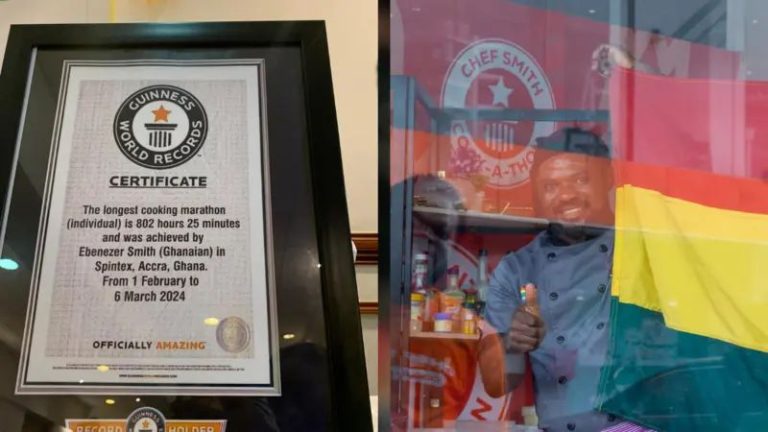
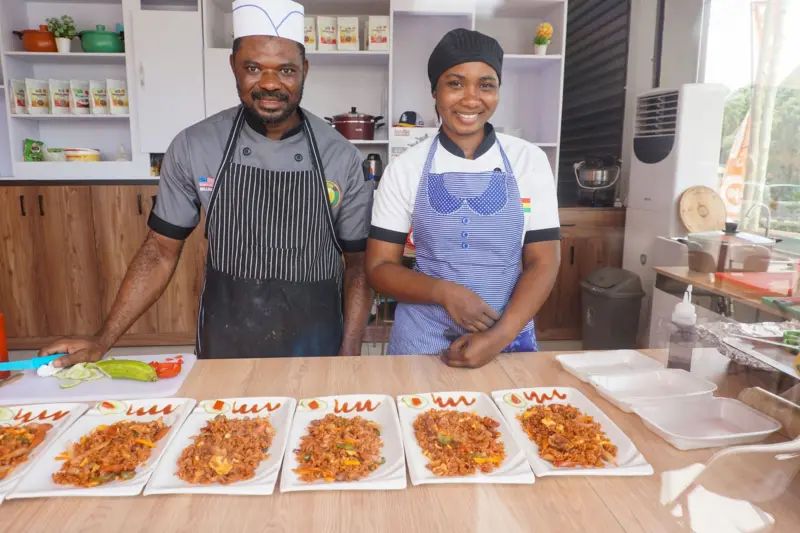
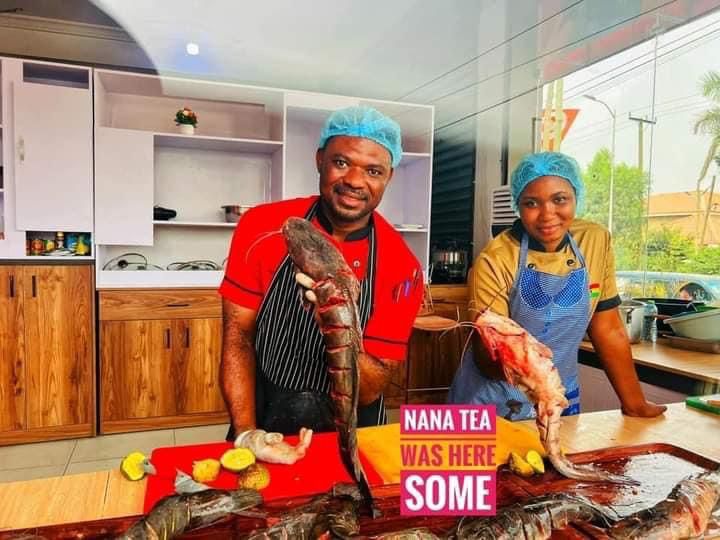
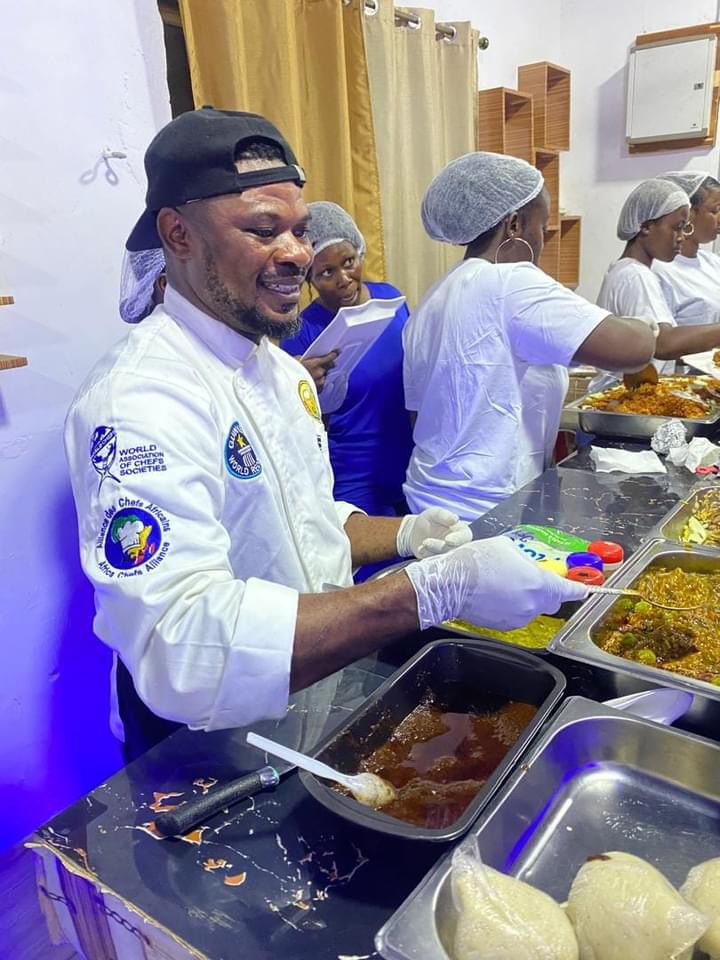
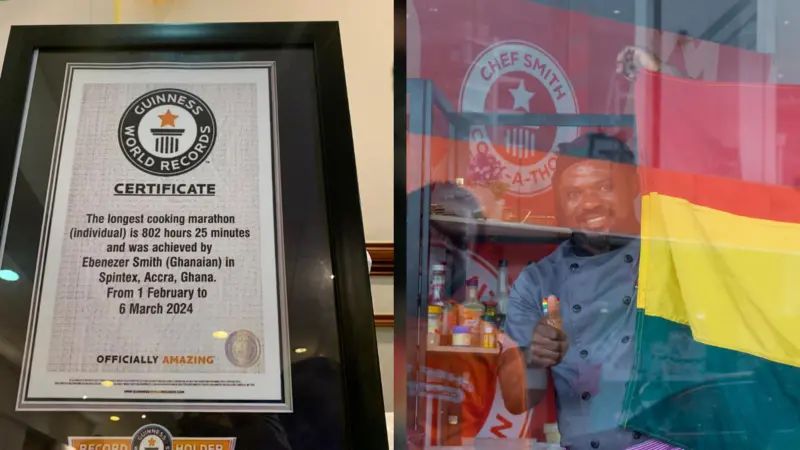
A Ghanaian chef, Ebenezer Smith, popularly known as Millennium Chef Smith, has been arrested and detained at the La Police Station for forging a Guinness World Record for marathon cooking.


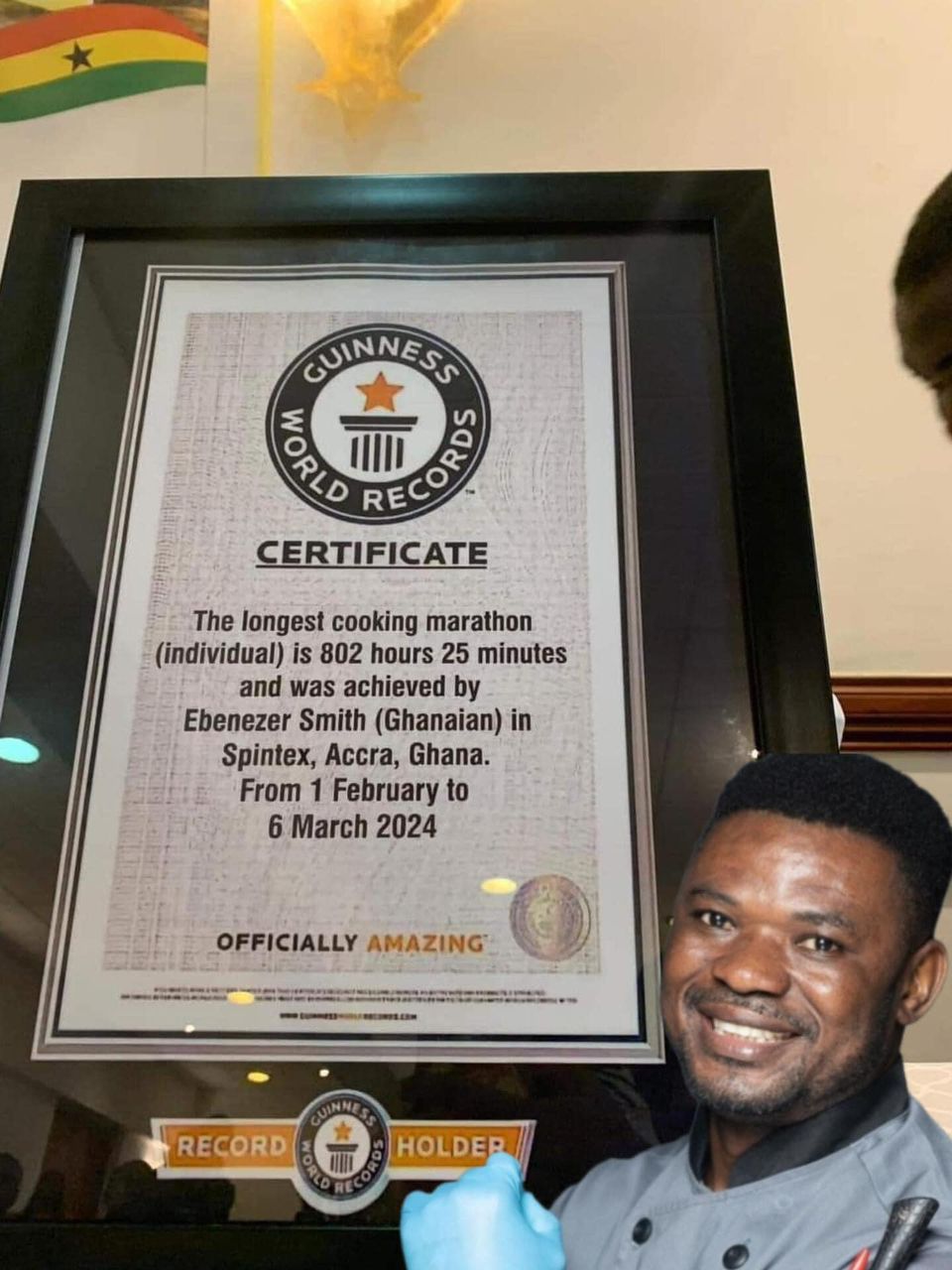
Smith on Tuesday presented a certificate confirming himself as the new world record holder for the 820-hour 25-minute cook-a-thon, which started on February 1 and ended on March 6, 2024, to his fans at a press conference.


Chef Smith. Source: Facebook

His cook-a-thon culminated in a star-studded event featuring performers such as Praye Tietia, Yaw Tog, Amerado, Kofi Jamar, and the Asakaa Boys.


During the briefing, which was held at La Palm Royal Beach Hotel in Accra, the chef said, “Today is the day that I will forever remember. I am incredibly humbled and honoured to stand before you today as the Guinness World Record holder.”


Chef Smith. Source: Facebook

Earlier, the Ghanaian chef wrote in a social media post, “It is with great pleasure and honour that we inform the general public and the media about Millennium Chef Smith’s press conference.


Chef Smith. Source: Facebook

“He will be announcing his results from the Guinness World Record for the longest cooking marathon by an individual. The event will take place at La Palm Royal Beach Hotel on Tuesday, July 2, 2024, at 2:00 pm. Thank you for your cooperation.”


Confirming the invalidity of his certificate to BBC, the PR Executive for GWR, Alina Polianskaya, said, “No, this is not true at all. He does not hold the GWR title, and that is not our certificate.


Chef Smith. Source: Facebook

“The current and true record holder is: The longest cooking marathon (individual) is 119hr 57 min 16 sec and was achieved by Alan Fisher (Ireland) in Matsue, Shimane, Japan, from 28 September to 3 October 2023,” he added.


Related News

Shortly after announcing his fake record and paraded his certificate, the police arrested him.


The PUNCH learned that Smith had gotten money from many of his sponsors to attempt a cook-a-thon that he did not properly file in for GWR and was arrested by a sponsor identified as the owner (name withheld) of the Amadia Shopping Mall who donated about 350,000 cedis to the course.


Every attempt to contact the LA Police for a comment proved abortive. Their number was unreachable, and the mail was not delivered to the address provided on their website.


Chef Smith. Source: Facebook

Irish chef Alan Fisher is the record holder for the longest cooking hours, having clocked in 119 hours and 57 minutes.


His feat is 24 hours more than the previous record held by Nigeria’s Hilda Baci.


“Alan Fisher (Ireland), an owner and chef of a restaurant in Japan, has broken two cooking-related Guinness World Records titles.


“First up, he’s claimed the longest cooking marathon (individual) after clocking in a time of 119 hours 57 minutes. That is more than 24 hours longer than the previous record held by Nigerian chef Hilda Baci.”

New price alert: Elon Musk set to introduce Starlink mini dish in Nigeria

The anticipated Starlink Mini dish, an inventive device, is scheduled to be introduced by SpaceX.

The new product is designed to give individuals in rural areas access to satellite-based internet service

Users are expected to gain from the device’s ease and flexibility as it is designed to fit easily in a backpack

Legit.ng journalist Zainab Iwayemi has over 3-year-experience covering the Economy, Technology, and Capital Market.


SpaceX is set to launch the much-awaited Starlink mini dish, an innovative gadget that promises to revolutionise internet accessibility, especially in underprivileged areas.


Elon Musk moves to introduce low-cost mini Starlink dish in Nigeria

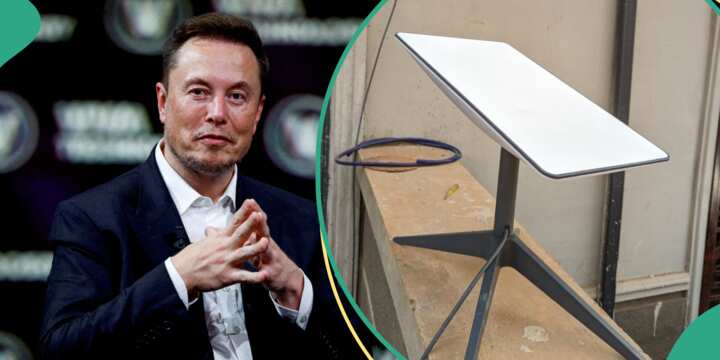
Starlink Mini is lightweight and simple to assemble. Photo Credit: Elon Musk Source: UGC

The new product aims to give people in isolated areas—where physical connections are unfeasible and mobile connections only offer restricted bandwidth—access to satellite-based internet service.


Starlink mini features

The Starlink mini is regarded as a game-changer and substantially smaller and more portable than the existing 23.4-inch by 15.07-inch Starlink dish, measuring only 11.4 inches by 9.8 inches.


It is lightweight and simple to assemble, weighing only 2.4 pounds (or 3.4 pounds when the kickstand and DC cord are included).


It is expected that users will benefit from the device’s unparalleled flexibility and convenience since it is made to fit comfortably in a backpack.


Due to its portability, it is considered the perfect travel companion for people who live in distant places or work remotely.


How Starlink has fared in Nigeria

With the introduction of Starlink into the Nigerian market by TD Africa, the continent’s largest distributor of tech items and the main distributor of Starlink products, the company has garnered public attention with its widely available satellite service.


According to the most recent Internet service provider (ISP) data made public by the Nigerian Communications Commission (NCC), Elon Musk’s Starlink internet business ranked third among all ISPs in Nigeria in terms of total subscribers during the fourth quarter (Q4) of 2023.


Elon Musk, the CEO of SpaceX, posted a speed test screenshot showing that the Starlink mini has a reasonable 11.5 Mbps upload speed and a strong 100 Mbps download speed with a 23 ms latency.


These features are more than sufficient to support numerous 4K video streams, smooth audio chats, video calls, and quick file downloads.


Prices and location to get products

The Punch reported that the mini dish will be available across e-commerce group in Nigeria and Starlink’s exclusive shop-in-shop merchant as soon as it is released.


The Starlink mini dish’s cost is one of its best features. It is expected that the gadget will probably be offered for half as much as a typical dish, which will enable more people to use it.


This pricing method will greatly increase adoption rates, especially in Nigeria where high-speed internet access has historically been hampered by cost.


It’s earlier reported that Starlink slashed the price of its hardware by 45% to N440,000 as the naira strengthened against the US dollar. This means that the new gadget could sell for N220,000 in Nigeria.


Nigerians abandon other networks

Legit.ng also previously reported that Nigerians are now opting for Starlink satellite internet kits as a solution to persistent fibre optic cable outages that impair internet connectivity.


This uses cutting-edge low-latency satellite technology to deliver high-speed internet services to consumers worldwide.


The demand for the Starlink satellite internet kits has been tremendous, according to e-commerce portal Konga, which has included the kits in its offerings.