



Home Blog Page 203

The Essential Roles of PR Strategists for Brands and Celebrities

The Essential Roles of PR Strategists for Brands and Celebrities


In today’s fast-paced media landscape, a public relations (PR) strategy is crucial for both brands and public figures. But what exactly does a PR strategist do? Their role extends far beyond just getting your name out there. Here’s how PR strategists contribute to the success and longevity of brands and public figures:


A PR Strategists helps in Building and Maintaining Relationships. PR strategists work tirelessly to establish and nurture positive relationships with the public, stakeholders, and the media. They ensure that interactions are positive and that your brand or image is consistently perceived well.


A PR Strategists also helps in Managing Perceptions about brand or a public figure. How the public perceives you or your brand can significantly impact success. PR strategists craft and control the narrative by highlighting achievements, values, and unique qualities. This deliberate management of public perception helps build a credible and trustworthy image.


A PR Strategists also help in Crisis Management. Inevitably, challenges and crises arise. A PR strategist is essential for navigating these turbulent times. They quickly and effectively address issues, mitigating negative impacts, and steering the narrative back to a positive direction. Their expertise in crisis management protects and preserves reputations.


As well Why You Need a PR strategists in managing relationships, perceptions, and crises, their value cannot be overstated. Whether you are a brand or a celebrity, a PR professional is crucial in managing and enhancing your public image.


Enhance your brand with expert PR management.


Adesina Kasali

PR/Media Strategist


#PRStrategies #PR

I was collecting N4,000 for a lead role in 2014” – Lateef Adedimeji

0

I was collecting N4,000 for a lead role in 2014” – Lateef Adedimeji says as he reveals the greatest advice his father gave him


Nollywood actor Lateef Adedimeji is reflecting on his early career days where he was collecting N4,000 for a lead role.


In an interview with Teju Oyelakin on Tejubabyface show, he revealed that as far back as 2014, he was being paid N4000 for a lead role. He added that he only started getting paid N100,000 to N200,000 for a role in 2015.


He revealed that his father once told him that the day he would know he is successful is when women are surrounding him to get his attention. His father added that the day he will also know that the time of doom is beat us when he can’t caution himself and start following the ladies.


His father rang into his ears that females come with the success and the ruin.


“If I tell people that I wasn’t collecting N100,000, N200,000 until 2015/16, a lot of people would not believe me.


Before then, the highest I collected for a lead role was either N4,000, N5,000, or N10,000. I was paid that low back in 2014 because it was more like a learning process.”


My father once told me that the day you know you are successful is when women are surrounding you to get your attention. The day you will also know that the time of doom is near is when you can’t caution yourself and you start following them back. Females come with the success and the ruin”.


“I was collecting N4,000 for a lead role in 2014”


– Actor Lateef Adedimeji

Federal Government has approved the prohibition of money r!tuals and glamourizing of vices in Nigerian films.

0

The Executive Director/CEO of National Film and Video Censors Board (NFVCB), Shaibu Husseini, says the Federal Government has approved the prohibition of money r!tuals and glamourizing of vices in Nigerian films.


Husseini disclosed this while speaking at a National Stakeholders Engagement on Smoke-Free Nollywood held in Enugu on Wednesday, May 22. The NFVCB boss said


today, we are facing an industry emergency requiring bold and ambitious actions from all parents, guardians and stakeholders.


“When my predecessor approached the former Minister of Information, Alhaji Lai Muhammed on the need to make a subsidiary legislation to curtail the display of smoking in Nigerian movies, he saw the need to include money rituals. Others included in the regulation are ritual killings and glamourising other crimes in order to further sanitise the film industry.


Today, I am delighted to announce to you that the Minister of Arts, Culture and the Creative Economy, Hannatu Musawa, pursuant to section 65 of the NFVCB Act 2004 has approved the regulation.


The minister has approved the Prohibition of Money Ritual, Ritual Killing, Tobacco, Tobacco Products, Nicotine Product Promotion and Glamorisation display in Movies, Musical Videos and Skits” Regulations 2024.


We have also forwarded the approved copy to the Federal Ministry of Justice for Gazette’’ he said


According to Husseini, besides the health implications, glamourising smoking in films poses a negative influence on teens and young adults who constitute the largest segment of Nigeria movie viewers. He said that the board was set to undertake detailed enlightenment programmes in secondary schools, tertiary institutions, local communities, faith groups and other institutions.

UK University orders Nigerian students to leave school

0

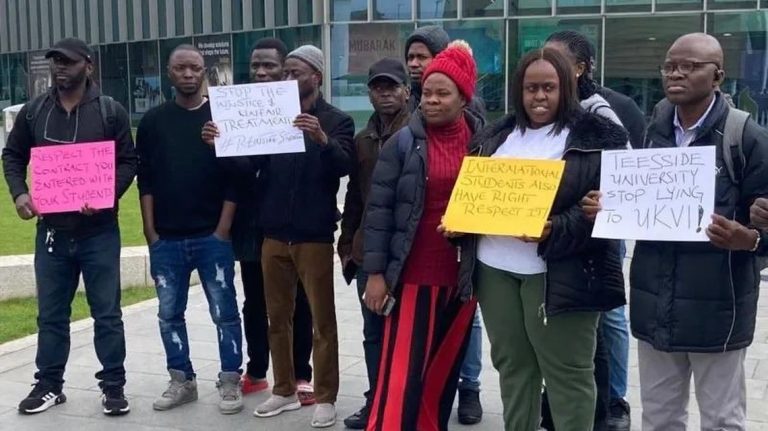
Nigerian students at Teesside University in the United Kingdom have been told to quit the school and return to Nigeria over unpaid fees.


The students were blocked from their studies and reported to the Home Office after the value of the Naira went down wiping out their savings.


According to BBC on Wednesday, May 22, a spokesperson of the University said failure to pay was a breach of visa sponsorship requirements, and that it had “no choice” but to alert the Home Office. The Home Office said visa sponsorship decisions rested with the institution.


A group of students, 60 of whom shared their names with the BBC, began pressing the university for support after some people who defaulted on payments were frozen out of university accounts and involuntarily withdrawn from their courses.


An affected student, Adenike Ibrahim, who was close to handing in her dissertation at the end of two years of study when she missed one payment, was kicked off her course and reported to the Home Office.


She said: “I did default [on payments], but I’d already paid 90% of my tuition fees and I went to all of my classes, I called them and asked to reach an agreement, but they do not care what happens to their students.


“It has been heartbreaking for my son especially, he has been in so much distress since I told him,” Ms Ibrahim added.


Another student, who preferred to remain anonymous, said he had considered suicide and was not drinking or eating.


Credit: NAN

Meet Babatunde Olatunji, Yoruba master drummer who influenced the world.

0

Meet Babatunde Olatunji, Yoruba master drummer who influenced the world.


A member of the Yoruba ethnic group, Olatunji was born in 1927 in the Nigerian village of Ajido, about forty miles from the capital of Lagos. His father was a fisherman. Traditional Yoruba drumming accompanied many of the events of village life, and Olatunji was taken by his great-aunt to hear drum ceremonies. The drummers celebrated every occasion, proclaimed the coming of local politicians, evoked the dreams and aspirations of their people. The drumbeat of his childhood became the life blood of his adult experience as Olatunji grew and traveled throughout the world popularizing the music of his Yoruban heritage.


While still in Africa in the late ’40s, the ever resourceful Olatunji read about the Rotary International Foundation scholarships offered to youths from war-affected countries. By 1950, Olatunji and his cousin were each awarded a scholarship and were on their way to America to attend school in Atlanta, Georgia. Olatunji came to the U.S. determined to succeed in the international arena, at the time he had no aspirations to be a musician.


In 1954, after graduating from Atlanta’s Moorehouse College with a degree in Diplomacy, Olatunji moved to New York to begin a Political Science postgraduate program in Public Administration at New York University.


Throughout his American education he had a unique perspective on the cultural divides between black and white Americans. Early on he realized that music, drumming in particular, had the ability to break down the long-established cultural divisions within the “Melting Pot” that America was thought to be in those days.


To cover his expenses he started a small drumming and dance group. Recognizing the influence of African polyrhythms in jazz, some of Olatunji’s earliest fans were the jazz greats of the time; men like John Coltrane, Yusef Lateef, Clark Terry, George Duvivier, Count Basie, Duke Ellington, Quincy Jones, and Dance luminary Alvin Ailey; not to mention the legendary producer John Hammond who produced Olatunji’s first album. Even Dr. Martin Luther King, Jr., (also a Moorehouse graduate) invited Olatunji to tour with him.

Kehinde Bankole wants you to know Funmilayo Ransome-Kuti did more than drive a car

Kehinde Bankole wants you to know Funmilayo Ransome-Kuti did more than drive a car

A new biopic centres around Ransome-Kuti leading the famous Abeokuta Women’s Revolt, a resistance movement led by the Abeokuta Women’s Union (AWU) in the late 1940s.

Kehinde Bankole is having a major moment. The actress has starred recently in a fleet of arthouse Nollywood films – Sista (2022), Adire (2023) – that have attained critical claim. For Adire she won Best Lead Actress at the recently concluded Africa Magic Viewers Choice Awards (AMVCA). She also landed the role of Moremi in Disney animated anthology series, Kizazi Moto (2023).


How does she decide the roles that she accepts?


“Definitely the story. Is it rooted in something? Then what is that something? And when I find that something, am I interested in telling the story?” she told Pulse Nigeria.


Bankole and Omowunmi Dada on the set of the film, Funmilayo Ransome Kuti


“Sometimes it’s just pure entertainment. I just chose like, ‘This is entertainment. I laughed while I was reading the script. People will feel good the way I felt. If I’m reading the script and I’m feeling good I want people to experience that.”


But for Funmilayo Ransome-Kuti, it was more than entertainment that piqued her interest.


“I felt very powerful,” she said of playing the character. “A very vital piece of history like this should not be hidden. It should also not be trivialised.”


Bankole accepted the role because she wanted to offer more perspective to Ransome-Kuti aside from being the first woman to drive a car and being the mother of the famous Afrobeats progenitor, Fela Anikulapo Kuti.


Funmilayo Ransome-Kuti, a leading woman activist in Nigeria and her son, the musician Fela

The film centres around Ransome-Kuti leading the famous Abeokuta Women’s Revolt (also called the Egba Women’s Tax Riot), a resistance movement led by the Abeokuta Women’s Union (AWU) in the late 1940s against the imposition of unfair taxation by the Nigerian colonial government.

“It should not just be the first woman to drive a car, Fela’s mom. No,” Bankole said. “It was a woman who led a movement, led a people, and even at a time, let the people know how powerful they were. There was nothing she did that she didn’t do with the help of the people. So the people at that time, I imagine how they must have felt so powerful because she let them know how much she needed them.”


Kehinde Bankole in Adire [Instagram/_kehindebankole]


Playing the role of the activist tagged the “Lioness of Lisabi” has also sparked in the actress a hunger for a similar agitator at a time of unprecedented economic upheaval across the country in contemporary times.


“That’s something we need now, somebody to let us believe in ourselves. Somebody to let us know who we are, the force that we are. And that if we all now come together and as a group of people, we can do so much,” she said.


Dennis Da-ala Mirilla

THE MBARI CLUB

0

THE MBARI CLUB


In the year 1961, in an old Lebanese restaurant at Dugbe market in Ibadan, a bunch of writers and visual artists, came together and founded what came to be known as the Mbari Club. The club was founded with the help of Ulli Beier, a teacher at the University of Ibadan.

The philosophy of the Mbari Club was that the arts operate from the centre of the culture, and is located in its historical heritage and traditional values which educate the masses and reflect the society’s values.


Mbari became a major confluence for Nigerian artists, but also attracted artists from across Africa. The club was so prestigious, it had the best artists in Nigeria as members – the likes of Chinua Achebe, Wole Soyinka, Christopher Okigbo, Demas Nwoko, John P. Clark etc.


At Mbari, open air performances were done by artists, there was a gallery where painters and sculptors exhibited their works and there was a library. Visual Arts giants like Yusuf Grillo, Bruce Onabrakpeya frequented the club and showcased their works.


The Premieres of Wole Soyinka’s “the Trial of brother Jero and JP Clark’s “Song of a goat” were staged at Mbari. It was also at Mbari that renowned Nigerian Singer, composer and activist, Fela Anikulapo-Kuti made his debut as a bandleader.


In its days, Mbari was host to internationally renowned artists like US poet Langston Hughes, and Jacob Lawrence, possibly the most widely acclaimed African American artist of the last century to either play or exhibit their works.


Ulli Beier, the German scholar who had helped the artists establish the club, began publishing the “Black Orpheus” literary magazine. At the time, the magazine was a platform for African writers to have their stories published without having to wait for journals in the UK or US.


Mbari was considered to be the only Africa-based publisher publishing titles by African authors like JP Clark, Wole Soyinka and Christopher Okigbo.


Mbari became the home for art, and the exhibition of the talent of the African continent and the new born Nation, Nigeria by giving visibility to the artists. Unfortunately, the breakout of the Civil war in 1967 interrupted probably the most successful movement of artists in Africa and the diaspora.


Peep that Peugot 403 parked in front of the club.

Hike in movie ticket prices drives Nigerian cinema’s N2.25B revenue in Q1 2024

0

The Nigerian cinema industry recorded a revenue of N2.25 billion from ticket sales in the first quarter (Q1) of 2024, reflecting a significant surge compared to the previous year.


This data was revealed in the Nigerian Box Office Year Book for 2023, published by Filmone Entertainment, an independent film distribution and production company, on Monday, according to the News Agency of Nigeria.


The N2.25 billion revenue marks a substantial improvement over the N1.5 billion generated in the first quarter of 2023. This represents a 46% increase in box office revenues year-on-year.


Revenue increase can be tied in part to the increase in ticket prices, which have risen by 52% from an average of N2,479 in Q1 2023 to N3,765 in Q1 2024.


A breakdown

Despite the substantial increase in revenue, the total number of admissions at cinemas saw a slight decline.


The first quarter of 2024 recorded 596,609 admissions, compared to 620,477 admissions during the same period in 2023, indicating a 4% decrease.

This decline in admissions, despite higher ticket prices, suggests a negative correlation between ticket prices and the number of cinemagoers.

The report highlights that Nollywood films dominated the box office, accounting for 56% of the total revenue.

The highest-grossing film for the period was “A Tribe Called Judah,” which alone contributed 27% of the overall Q1 revenue. In contrast, Warner Bros.’ “Aquaman and the Lost Kingdom” accounted for 11% of the quarterly earnings.

In terms of new content, the Nigerian market saw the release of 40 new titles in the first quarter, excluding spillovers from previous periods. This influx of new films underscores the vibrancy and productivity of the local film industry.


What to know

The details provided in the report offer a comprehensive look at the dynamics of Nigeria’s cinema sector. The significant revenue growth, despite a decline in admissions, shows that ehe substantial increases in ticket prices have not deterred overall revenue growth but impacted the number of admissions. This indicates a level of price sensitivity among cinema-goers.


The dominance of Nollywood films, particularly “A Tribe Called Judah,” highlights the strong local preference for indigenous content, which continues to draw significant box office revenues.


The cinema industry’s ability to generate higher revenues in the face of reduced admissions reflects its resilience and the effectiveness of pricing strategies and marketing efforts.


More insight

Looking ahead, the continued performance of the cinema sector will depend on several factors, including the balance of ticket pricing, the quality and appeal of film releases, and broader economic conditions. The robust performance in Q1 2024 sets a positive tone for the rest of the year, suggesting that with strategic adjustments, the sector could continue to thrive despite the challenges posed by fluctuating admission numbers.

Hike in movie ticket prices drives Nigerian cinema’s N2.25B revenue in Q1 2024

0

Hike in movie ticket prices drives Nigerian cinema’s N2.25B revenue in Q1 2024


The Nigerian cinema industry recorded a revenue of N2.25 billion from ticket sales in the first quarter (Q1) of 2024, reflecting a significant surge compared to the previous year.


This data was revealed in the Nigerian Box Office Year Book for 2023, published by Filmone Entertainment, an independent film distribution and production company, on Monday, according to the News Agency of Nigeria.


The N2.25 billion revenue marks a substantial improvement over the N1.5 billion generated in the first quarter of 2023. This represents a 46% increase in box office revenues year-on-year.


Revenue increase can be tied in part to the increase in ticket prices, which have risen by 52% from an average of N2,479 in Q1 2023 to N3,765 in Q1 2024.


A breakdown

Despite the substantial increase in revenue, the total number of admissions at cinemas saw a slight decline.


The first quarter of 2024 recorded 596,609 admissions, compared to 620,477 admissions during the same period in 2023, indicating a 4% decrease.

This decline in admissions, despite higher ticket prices, suggests a negative correlation between ticket prices and the number of cinemagoers.

The report highlights that Nollywood films dominated the box office, accounting for 56% of the total revenue.

The highest-grossing film for the period was “A Tribe Called Judah,” which alone contributed 27% of the overall Q1 revenue. In contrast, Warner Bros.’ “Aquaman and the Lost Kingdom” accounted for 11% of the quarterly earnings.

In terms of new content, the Nigerian market saw the release of 40 new titles in the first quarter, excluding spillovers from previous periods. This influx of new films underscores the vibrancy and productivity of the local film industry.


What to know

The details provided in the report offer a comprehensive look at the dynamics of Nigeria’s cinema sector. The significant revenue growth, despite a decline in admissions, shows that ehe substantial increases in ticket prices have not deterred overall revenue growth but impacted the number of admissions. This indicates a level of price sensitivity among cinema-goers.


The dominance of Nollywood films, particularly “A Tribe Called Judah,” highlights the strong local preference for indigenous content, which continues to draw significant box office revenues.


The cinema industry’s ability to generate higher revenues in the face of reduced admissions reflects its resilience and the effectiveness of pricing strategies and marketing efforts.


More insight

Looking ahead, the continued performance of the cinema sector will depend on several factors, including the balance of ticket pricing, the quality and appeal of film releases, and broader economic conditions. The robust performance in Q1 2024 sets a positive tone for the rest of the year, suggesting that with strategic adjustments, the sector could continue to thrive despite the challenges posed by fluctuating admission numbers.

You told filmmakers not to hire me’, actress Motilola Akinlami calls out colleague, Kunle Afod

0

Actress Motilola Akinlami has accused her senior colleague, Kunle Afod, of obstructing her career in Nollywood by claiming he blocks her from getting roles.


In an Instagram post on Monday, she claimed that Kunle has consistently undermined her career by preventing producers from reaching out to her for roles in the industry. She also accused the actor’s wife of defaming her.

Her words: “I am boiling inside of me right now. I have kept this thing for over five years. This is the fifth year running. I beg you in the name of God. All the powers that be in this industry already know about this matter. Mr. Kunle Afod please leave me alone. Please leave me and my career. What have I done to you? They will call me for jobs you will say they should remove me if they want to use you.


“Yomi Olorunlaye called me for a job this evening and they said Afod will direct. And I said okay. Only for him to call me back that Afod said he cannot work with me. Afod what have I done? I have told you I no longer want to work with you. For all these years you said they should not call me for jobs any longer.


“When I was working with you, I knew how your wife was running from pillar to post defaming me on Instagram. Go and hold your wife. Leave me alone. You said Femi Adebayo should not come to my set, and he is no longer coming. This is like the tenth time I will be rejected for jobs.


“So many people have been asking me why they have not been seeing me in movies. It is because of Afod. If they call me, he will say they should not call me. The reason is that I no longer want to be friends with him. This was how they did to Junior Pope. They will first blacklist you. He has been waiting to see my RIP for the past five years, but God was with me. You are not God. You have been obstructing me on so many big jobs I ought to have been on,” she said.